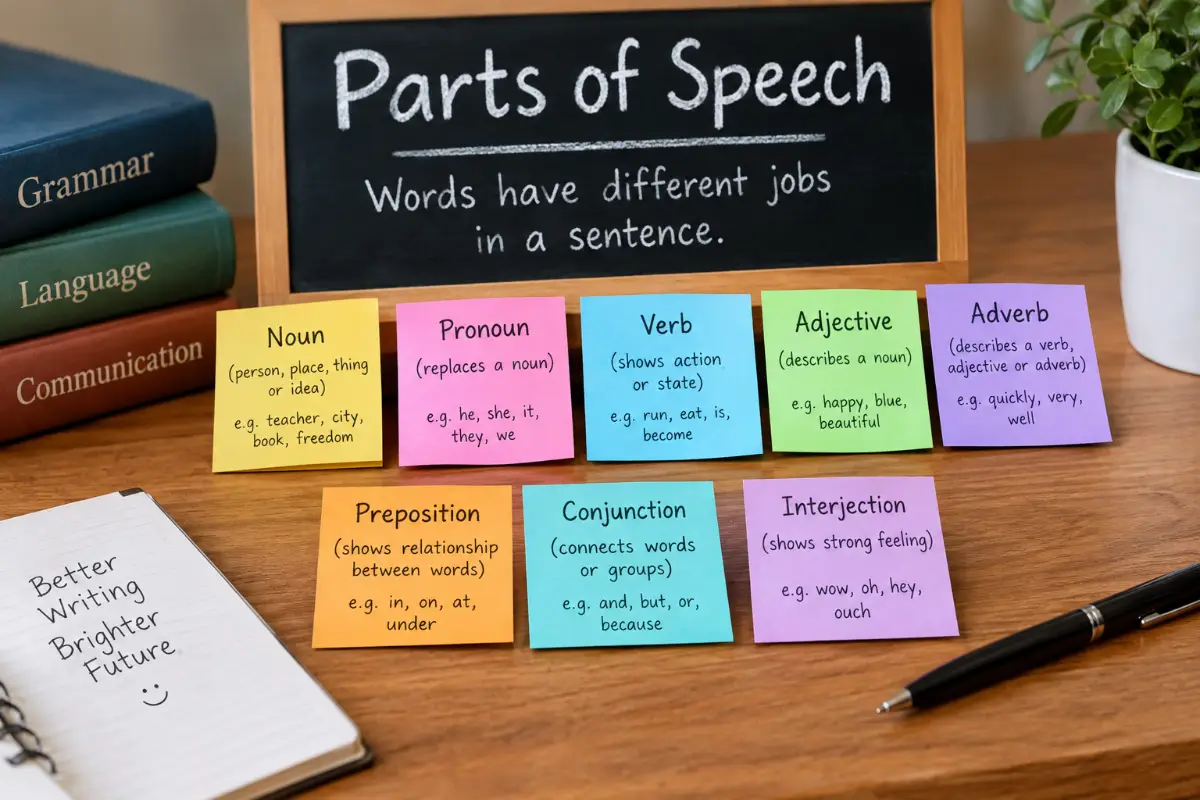
Understanding English grammar becomes easier when you learn the parts of speech and how words work in a sentence. Some words name people or things, others describe actions, and some connect ideas or express feelings. Each word performs a particular grammatical function, helping you build clear, correct, and meaningful sentences.
Learning these functions helps you write correct sentences, improve your vocabulary, avoid common mistakes, and communicate more confidently in English.
This guide explains the eight traditional parts of speech, their types, examples, and rules. It also covers common mistakes, practical identification techniques, and frequently asked questions to help students, teachers, writers, and English learners strengthen their grammar skills.
What Are Parts of Speech?
Parts of speech are categories of words classified according to their functions in sentences. Each category performs a particular role, such as naming something, expressing an action, describing a person, or connecting two ideas.
Consider this example:
The clever student quickly solved the difficult problem.
Each word has a different function:
- The: Introduces a noun.
- Clever: Describes the student.
- Student: Names a person.
- Quickly: Explains how the action happened.
- Solved: Expresses an action.
- The: Introduces another noun.
- Difficult: Describes the problem.
- Problem: Names a thing or task.
English traditionally has eight main word classes: nouns, pronouns, verbs, adjectives, adverbs, prepositions, conjunctions, and interjections. Modern grammar also recognizes categories such as determiners, which include words like the, a, and an.
Understanding these categories helps you see how individual words combine to form meaningful sentences.
Why Are Word Classes Important?
Learning grammar categories offers several practical benefits:
- Better writing: You can construct clear, meaningful sentences.
- Improved speaking: You can express your ideas more accurately.
- Fewer mistakes: You can recognize errors involving verbs, pronouns, and modifiers.
- Stronger reading skills: You understand how words contribute to meaning.
- Better exam preparation: Grammar questions often require identifying word classes.
- Vocabulary development: You learn how the same word can serve different purposes.
For example, compare these sentences:
- She is a careful driver.
- She drives carefully.
In the first sentence, careful describes the noun driver. In the second, carefully explains how she drives.
Recognizing this difference helps you choose the correct word in different situations.
The Eight Traditional Word Classes
The following table summarizes the main categories and their functions.
| Word class | Function | Examples |
|---|---|---|
| Noun | Names a person, place, thing, or idea | Teacher, city, book |
| Pronoun | Refers to a noun or noun phrase | She, they, someone |
| Verb | Expresses an action, state, or occurrence | Run, think, become |
| Adjective | Describes a noun or pronoun | Beautiful, tall, clever |
| Adverb | Modifies a verb, adjective, or another adverb | Slowly, very, often |
| Preposition | Shows relationships between words | In, on, under |
| Conjunction | Connects words, phrases, or clauses | And, but, because |
| Interjection | Expresses a feeling or reaction | Wow, oh, ouch |
Let’s explore each category with simple explanations and examples.
1. Noun: A Word That Names Something
A noun names a person, place, animal, object, or idea. Nouns are essential because they often identify the people or things a sentence discusses.
Examples:
- People: Teacher, doctor, student
- Places: School, Lahore, garden
- Animals: Cat, rabbit, elephant
- Things: Book, computer, chair
- Ideas: Honesty, courage, happiness
Example: The student reads a book in the library.
In this sentence, student, book, and library are nouns because they name a person, an object, and a place.
Types of Nouns
Common nouns name general people, places, or things.
Examples: girl, country, river.
Sentence: The girl visited a museum.
Proper nouns identify specific people, places, organizations, or other named entities. They usually begin with capital letters.
Examples: Ayesha, Pakistan, Monday.
Sentence: Ayesha lives in Pakistan.
Concrete nouns refer to things that can be experienced through the senses.
Examples: apple, stone, perfume.
Abstract nouns name feelings, qualities, or ideas that cannot usually be physically touched.
Examples: love, wisdom, freedom.
Sentence: Honesty builds trust.
Collective nouns refer to groups.
Examples: team, family, crowd, flock.
Sentence: The team celebrated its victory.
Countable and uncountable nouns differ in how they are counted.
| Countable nouns | Uncountable nouns |
|---|---|
| Apple, chair, coin | Water, furniture, money |
| Three apples | Some water |
| Two chairs | Some furniture |
For example, we say three apples but usually some information, not three informations.
How to Identify a Noun
Ask yourself: Who or what is being named?
In the sentence Kindness makes the world better, kindness is an abstract noun.
Nouns can function as subjects, direct objects, indirect objects, or complements. Their exact function depends on the sentence.
2. Pronoun: A Word That Refers to a Noun
A pronoun refers to a person or thing, often replacing a noun or noun phrase to prevent repetition.
Consider this example:
Sara is my friend. Sara is helpful. Sara studies hard.
The repeated name sounds awkward. A better version is:
Sara is my friend. She is helpful. She studies hard.
Here, she refers to Sara.
Types of Pronouns
Personal pronouns refer to people or things.
Examples: I, me, you, he, him, she, her, it, we, us, they, them.
Sentence: They are waiting outside.
Possessive pronouns indicate ownership.
Examples: mine, yours, his, hers, ours, theirs.
Sentence: This book is mine.
Compare my book with the book is mine. Here, my is a possessive determiner, while mine is a possessive pronoun.
Reflexive pronouns refer back to the subject.
Examples: myself, yourself, himself, herself, ourselves, themselves.
Sentence: She prepared herself for the exam.
Demonstrative pronouns point to particular people or things.
Examples: this, that, these, those.
Sentence: These are delicious.
Interrogative pronouns help form questions.
Examples: who, whom, whose, what, which.
Sentence: Who is at the door?
Relative pronouns introduce clauses that provide information about nouns.
Examples: who, whom, whose, which, that.
Sentence: The woman who called you is my aunt.
Indefinite pronouns refer to people or things without identifying them precisely.
Examples: someone, anyone, everyone, nobody, something.
Sentence: Someone left a bag here.
Common Pronoun Mistakes
Incorrect: Everyone have a chance.
Correct: Everyone has a chance.
Although everyone refers to many people, it generally takes a singular verb.
Also, ensure that pronouns clearly refer to the correct person or thing.
Unclear: Ali told Ahmed that he had won.
It is unclear whether Ali or Ahmed won. Rewriting the sentence can remove the confusion.
3. Verb: A Word That Expresses an Action or State
A verb expresses an action, state, or occurrence. Most complete English sentences contain a verb.
Examples include run, write, think, is, seem, and become.
Consider these sentences:
- The children play outside.
- She is happy.
- The leaves fell.
The verbs are play, is, and fell.
Types of Verbs
Action verbs describe physical or mental activities.
Examples: jump, read, imagine, remember.
Sentence: He writes every morning.
Linking verbs connect the subject with information that describes or identifies it.
Examples: be, seem, become, appear, feel when used as linking verbs.
Sentence: The soup smells delicious.
Helping verbs work with main verbs to express tense or other meanings.
Examples: am, is, are, was, have, has, do, does.
Sentence: She is studying English.
Modal verbs express ability, possibility, permission, advice, or necessity.
Examples: can, could, may, might, must, should, will, would.
Sentences: I can swim. / You should rest.
Transitive verbs take a direct object.
Example: She opened the door.
Intransitive verbs do not require a direct object.
Example: The baby slept.
Verb Tenses
Verb tenses help communicate when an action happens.
| Tense | Example | Use |
|---|---|---|
| Simple present | She works. | Habits and general truths |
| Simple past | She worked. | Completed past actions |
| Simple future | She will work. | Future actions |
| Present continuous | She is working. | Actions in progress |
| Present perfect | She has worked. | Past actions connected to the present |
The correct verb form depends on the subject, time, and intended meaning.
Common Verb Mistakes
Incorrect: He go to school every day.
Correct: He goes to school every day.
Incorrect: They was playing football.
Correct: They were playing football.
Always check subject-verb agreement and use helping verbs correctly.

4. Adjective: A Word That Describes
An adjective describes a noun or pronoun. It can tell us about appearance, size, color, age, quantity, or quality.
Examples include beautiful, small, blue, young, and honest.
Sentence: The clever student solved a difficult problem.
Here, clever describes the student, while difficult describes the problem.
Types of Adjectives
Descriptive adjectives express qualities.
Examples: kind, tall, bright, delicious.
Quantitative words indicate amount or quantity.
Examples: some, much, little, enough.
Sentence: We have enough time.
In modern grammar, many such words are classified as determiners or quantifiers rather than adjectives.
Demonstrative adjectives, in traditional school grammar, identify particular nouns.
Examples: this book, those flowers.
Possessive adjectives, traditionally so called, indicate ownership or association.
Examples: my brother, your bag, their house.
Modern grammar usually classifies my, your, and their as possessive determiners.
Proper adjectives come from proper nouns.
Examples: Pakistani food, Victorian architecture.
Degrees of Comparison
Adjectives can compare qualities.
| Degree | Example |
|---|---|
| Positive | Tall |
| Comparative | Taller |
| Superlative | Tallest |
Examples:
- Ali is tall.
- Ali is taller than Ahmed.
- Ali is the tallest student in the class.
Longer adjectives commonly use more and most:
Beautiful, more beautiful, most beautiful.
Some adjectives have irregular forms, such as good, better, best and bad, worse, worst.
Common Adjective Mistakes
Incorrect: She is more smarter than me.
Correct: She is smarter than me.
Avoid using more with an adjective that already has the comparative ending -er.
Remember that adjectives describe nouns, while adverbs often describe actions.
- He is a careful driver.
- He drives carefully.
5. Adverb: A Word That Adds Information
An adverb modifies a verb, adjective, another adverb, or sometimes an entire sentence. It often explains how, when, where, how often, or to what extent something happens.
Examples include quickly, yesterday, outside, often, and very.
Sentence: The teacher explained the lesson clearly.
Here, clearly explains how the teacher explained the lesson.
Types of Adverbs
Adverbs of manner explain how an action happens.
Examples: slowly, carefully, quietly.
Sentence: She answered confidently.
Adverbs of time explain when something happens.
Examples: today, yesterday, soon, later.
Sentence: We will leave tomorrow.
Adverbs of place explain where something happens.
Examples: here, there, everywhere, outside.
Sentence: The children are playing outside.
Adverbs of frequency explain how often something happens.
Examples: always, usually, often, sometimes, rarely, never.
Sentence: He often visits his grandparents.
Adverbs of degree indicate intensity or extent.
Examples: very, quite, too, almost, extremely.
Sentence: The water is extremely cold.
Sentence adverbs express an attitude toward an entire statement.
Examples: fortunately, honestly, probably.
Sentence: Fortunately, nobody was injured.
Common Adverb Mistakes
Not all adverbs end in -ly. Words such as fast, well, often, and here can function as adverbs.
Compare:
- He is a fast runner.
- He runs fast.
In the first sentence, fast is an adjective. In the second, it is an adverb.
Also, remember the difference between good and well.
Incorrect: She sings good.
Correct: She sings well.
However, good is correct in She is a good singer because it describes the noun singer.
Some linking verbs take adjectives rather than adverbs:
- The flowers smell sweet.
- She looked happy.
Here, sweet and happy describe the subjects.
6. Preposition: A Word That Shows Relationships
A preposition shows the relationship between a noun or pronoun and another part of a sentence. It can express place, time, direction, position, or other connections.
Common prepositions include in, on, at, under, over, between, through, from, and with.
Examples:
- The keys are on the table.
- We arrived at noon.
- She walked through the park.
- He traveled with his friends.
Types of Prepositions
Prepositions of place indicate location.
Examples: in, on, under, behind, beside, between.
Sentence: The cat is under the chair.
Prepositions of time indicate when something happens.
Examples: at, on, in, before, after, during.
- At 9 a.m.
- On Monday.
- In October.
Prepositions of direction show movement.
Examples: to, into, onto, toward, across, through.
Sentence: She walked into the room.
Prepositions expressing relationships, cause, or purpose include expressions such as about, with, for, and because of.
Sentences:
- They spoke about the project.
- This gift is for you.
- The match was canceled because of rain.
Common Preposition Combinations
| Expression | Example |
|---|---|
| Interested in | She is interested in science. |
| Good at | He is good at mathematics. |
| Afraid of | The child is afraid of dogs. |
| Depend on | Success depends on preparation. |
| Listen to | Listen to the teacher. |
| Arrive at | We arrived at the station. |
| Arrive in | They arrived in Pakistan. |
A prepositional phrase begins with a preposition and includes its object and any words modifying that object.
Examples: under the bed, after the meeting, with my friend.
Sentence: The children played in the large garden.
The phrase in the large garden tells us where the children played.
7. Conjunction: A Word That Connects Ideas
A conjunction connects words, phrases, or clauses. It helps combine ideas and shows relationships such as contrast, reason, choice, and condition.
Examples include and, but, or, because, although, and if.
Sentences:
- Sara and Ahmed are classmates.
- I wanted to go, but I was busy.
- We stayed home because it was raining.
Types of Conjunctions
Coordinating conjunctions connect elements of equal grammatical importance.
The seven coordinating conjunctions are remembered using FANBOYS.
| Conjunction | Example |
|---|---|
| For | I stayed inside, for it was raining. |
| And | She bought bread and milk. |
| Nor | He neither called nor wrote. |
| But | I was tired, but I continued. |
| Or | Would you like tea or coffee? |
| Yet | It was difficult, yet she succeeded. |
| So | It was late, so we left. |
Subordinating conjunctions introduce dependent clauses and show relationships such as time, reason, condition, or contrast.
Examples: because, although, since, when, while, unless, if.
Sentences:
- I stayed home because I was sick.
- Although it was cold, we went outside.
- You will improve if you practice.
Correlative conjunctions work in pairs.
Examples: either … or, neither … nor, both … and, not only … but also.
Sentences:
- Either you or your brother must answer.
- Both Ali and Ahmed attended.
- She is not only intelligent but also hardworking.
Common Conjunction Mistakes
Incorrect: I was tired, I went to bed.
Correct: I was tired, so I went to bed.
The incorrect sentence joins two independent clauses using only a comma. You can correct it with a conjunction, a semicolon, or separate sentences.
8. Interjection: A Word That Expresses Emotion
An interjection expresses a sudden feeling or reaction. It can communicate surprise, excitement, pain, disappointment, or relief.
Examples include Wow!, Oh!, Ouch!, Hurray!, Alas!, and Oops!.
| Interjection | Meaning | Example |
|---|---|---|
| Wow! | Surprise or admiration | Wow! That painting is beautiful. |
| Ouch! | Pain | Ouch! I hurt my finger. |
| Hurray! | Celebration | Hurray! We won the match. |
| Oh! | Realization or surprise | Oh! Now I understand. |
| Oops! | A mistake | Oops! I dropped the glass. |
| Alas! | Sorrow or regret | Alas! We missed the opportunity. |
| Phew! | Relief | Phew! That was difficult. |
Interjections are common in conversations, dialogue, and informal writing. They are generally less common in formal academic writing.
How to Punctuate Interjections
Use an exclamation mark when the emotion is strong:
Wow! You did an excellent job.
For a milder reaction, a comma may be appropriate:
Well, I think we should try again.
Punctuation depends on the tone and intensity of the expression.
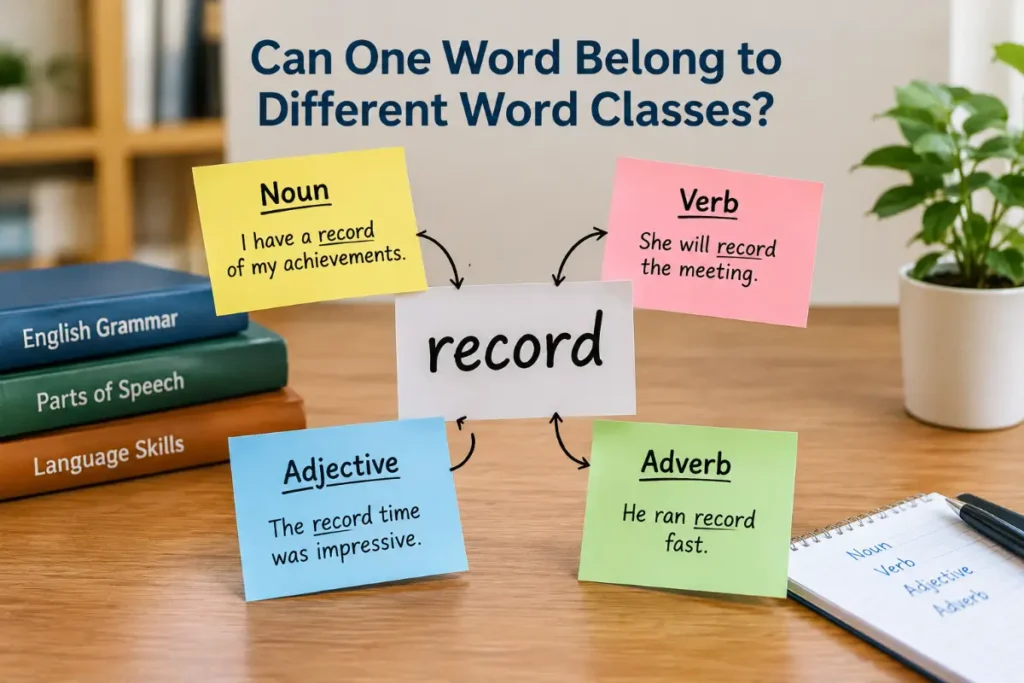
Can One Word Belong to Different Word Classes?
Yes. A word’s grammatical category can change depending on its function in a sentence. This is why context matters.
Consider the word light:
- The light is bright. — Noun
- This is a light bag. — Adjective
- Please light the candle. — Verb
The spelling stays the same, but the word performs different grammatical jobs.
More examples:
| Word | Sentence | Word class |
|---|---|---|
| Run | I go for a run. | Noun |
| Run | I run every morning. | Verb |
| Fast | He drives a fast car. | Adjective |
| Fast | He drives fast. | Adverb |
| Before | We arrived before noon. | Preposition |
| Before | We arrived before the show began. | Conjunction |
These examples follow common school-grammar classifications. Modern grammar may analyze certain words differently.
Remember: Identify a word by its function in the sentence, not simply by its spelling.
Parts of Speech vs. Parts of a Sentence
Word classes and sentence elements are related but different.
Word classes describe the types of words. Sentence elements describe the roles that words or phrases perform within a sentence.
Consider this sentence:
The young boy kicked the ball.
- Boy is a noun functioning as the subject.
- Kicked is a verb functioning as the main verb.
- Ball is a noun functioning as the direct object.
- Young is an adjective describing boy.
| Word classes | Possible sentence functions |
|---|---|
| Noun | Subject, object, or complement |
| Pronoun | Subject or object |
| Verb | Main verb or part of a verb phrase |
| Adjective | Modifier or subject/object complement |
| Adverb | Adverbial modifier |
| Prepositional phrase | Modifier or adverbial |
A noun is not always a subject, and a verb is not always the only element in a verb phrase. The function depends on how the word is used.
Understanding this distinction makes sentence analysis much easier.
How to Identify Word Classes in a Sentence
Follow these steps when analyzing a sentence.
Step 1: Find naming words. Look for words that identify people, places, things, or ideas. These are often nouns.
Step 2: Find the verb. Identify the action, state, or occurrence. Check for helping verbs.
Step 3: Look for descriptions. Identify words that describe nouns or pronouns. These are often adjectives.
Step 4: Find additional details. Look for words explaining how, when, where, or how often something happens. These may be adverbs.
Step 5: Check relationships and connections. Identify prepositions, conjunctions, and interjections.
Example Sentence Analysis
Consider:
Wow! The intelligent student quickly solved the difficult question because she practiced regularly.
| Word | Word class | Function |
|---|---|---|
| Wow! | Interjection | Expresses surprise |
| The | Determiner | Introduces a noun |
| Intelligent | Adjective | Describes the student |
| Student | Noun | Names a person |
| Quickly | Adverb | Describes how the student solved the question |
| Solved | Verb | Expresses an action |
| Difficult | Adjective | Describes the question |
| Question | Noun | Names a task |
| Because | Conjunction | Introduces a reason |
| She | Pronoun | Refers to the student |
| Practiced | Verb | Expresses an action |
| Regularly | Adverb | Describes the frequency of practice |
Notice that the is classified as a determiner in modern grammar. Some traditional school resources teach articles alongside adjectives.
Common Mistakes When Learning Word Classes
Understanding definitions is only the first step. You also need to recognize how words work in real sentences.
| Incorrect usage | Correct usage | Explanation |
|---|---|---|
| She sings beautiful. | She sings beautifully. | An adverb describes how she sings. |
| He is more taller. | He is taller. | Avoid double comparison. |
| They was happy. | They were happy. | Use the correct verb form. |
| I need an information. | I need some information. | Information is usually uncountable. |
| She is good at to swim. | She is good at swimming. | Use a gerund after this expression. |
| I was tired, I slept. | I was tired, so I slept. | Join the clauses correctly. |
Mistake 1: Assuming Every -ly Word Is an Adverb
Many adverbs end in -ly, but some adjectives do too.
Examples: friendly, lovely, lonely.
Sentence: She is a friendly person.
Here, friendly is an adjective.
Mistake 2: Confusing Adjectives and Adverbs
Compare:
- The careful student checked the answer.
- The student checked the answer carefully.
Careful describes the student, while carefully describes the action.
Mistake 3: Expecting Every Sentence to Contain All Eight Categories
A sentence does not need every word class to be complete.
Example: Birds fly.
This simple sentence contains a noun and a verb.
Mistake 4: Memorizing Without Practicing
Definitions are helpful, but practice develops real understanding. Read short sentences, identify individual words, and explain their grammatical functions.
Try using the same word in different sentences to understand how its role changes.
Practice Quiz: Test Your Understanding
Identify the word class of the bold word in each sentence.
- The dog barked loudly.
- She spoke politely.
- They are playing outside.
- It is a beautiful painting.
- The keys are under the table.
- I was tired, but I finished my work.
- Ouch! That hurts.
- Birds sing in the morning.
Answers and Explanations
- Dog — Noun: It names an animal.
- Politely — Adverb: It explains how she spoke.
- They — Pronoun: It refers to people.
- Beautiful — Adjective: It describes the painting.
- Under — Preposition: It shows a spatial relationship.
- But — Conjunction: It connects contrasting clauses.
- Ouch — Interjection: It expresses pain.
- Sing — Verb: It expresses an action.
Review any incorrect answers and try identifying the same categories in your own writing.
Frequently Asked Questions (FAQs)
1. What are the eight traditional word classes?
They are nouns, pronouns, verbs, adjectives, adverbs, prepositions, conjunctions, and interjections. Each category describes a different grammatical function.
2. Why are word classes important?
They help you understand sentence structure, choose appropriate words, improve writing, and avoid common grammar mistakes.
3. What is the easiest way to remember them?
Learn their basic functions: nouns name, pronouns refer, verbs express actions or states, adjectives describe, adverbs modify, prepositions show relationships, conjunctions connect, and interjections express feelings.
4. What is the difference between a noun and a pronoun?
A noun names a person, place, thing, or idea. A pronoun refers to someone or something, often replacing a noun phrase.
Example: Ayesha is reading. She enjoys the book.
Ayesha is a noun, while she is a pronoun.
5. What is the difference between an adjective and an adverb?
An adjective generally describes a noun or pronoun, while an adverb modifies a verb, adjective, another adverb, or sometimes a whole sentence.
Examples: a slow runner and runs slowly.
6. Can one word belong to more than one word class?
Yes. Its category depends on its function in context.
Example: I have work to do uses work as a noun, while I work every day uses it as a verb.
7. Are there more than eight word classes?
Yes, depending on the grammar system. Modern grammar commonly recognizes determiners as a separate category, while traditional school grammar often uses the eight-category model.
8. What are the word classes in “She quickly opened the door”?
- She — Pronoun
- Quickly — Adverb
- Opened — Verb
- The — Determiner
- Door — Noun
9. Which word class is the most important?
No single category is always the most important. Verbs are central to most complete sentences, while nouns, pronouns, and other categories help express participants, descriptions, and relationships.
10. How can I improve my grammar skills?
Read English regularly, write short sentences, identify word classes, and review mistakes. Consistent practice helps you apply grammar rules naturally.
Conclusion
Understanding the eight traditional word classes provides a strong foundation for learning English grammar. Nouns name people and things, pronouns refer to them, verbs express actions and states, adjectives describe, adverbs add details, prepositions show relationships, conjunctions connect ideas, and interjections express emotions.
The best way to learn these categories is to study them in context rather than memorizing definitions alone. Practice identifying words in sentences, notice how their functions change, and review common mistakes.
Start with simple examples and gradually analyze more complex sentences. With regular practice, you will find it easier to understand grammar, write clearer sentences, and communicate confidently in English.