The New England Patriots and Chicago Bears delivered an exciting Thursday Night Football matchup on October 22, 2026. The Bears defeated the Patriots 30–24 at Soldier Field in Chicago, earning an important home victory in Week 7 of the NFL regular season. Chicago built an early lead, handled New England’s comeback attempts, and secured the win with a clutch 58-yard field goal from Cairo Santos.
For fans looking for patriots vs bears match player stats, the biggest performances came from quarterbacks Drake Maye and Caleb Williams, Bears wide receiver Luther Burden III, and Patriots running back Rhamondre Stevenson. Williams threw for 308 yards and two touchdowns without an interception, while Maye passed for 321 yards and accounted for three total touchdowns.
The game also featured an end-zone interception, productive receiving performances, and several important third- and fourth-down plays. Below, you’ll find the final score, player statistics, team comparisons, scoring summary, standout performances, and answers to common questions about the matchup.
Patriots vs Bears Game at a Glance
Patriots
New England
24
Final
Week 7
Oct. 22, 2026
Bears
Chicago
30
Venue
Soldier Field, Chicago
Game
Thursday Night Football
Winning team
Chicago Bears
Final margin
Bears by 6
The Bears improved to 5–2, while the Patriots dropped to 4–3. Chicago’s ability to protect its lead and avoid turnovers proved especially important against a New England offense that continued to threaten throughout the game.
1. Patriots vs Bears Match Player Stats: Quarterback Comparison
Quarterback performance shaped the entire contest. Both teams produced more than 300 passing yards, but Chicago’s ability to avoid turnovers gave the Bears a meaningful advantage.
| Passing stat | Drake Maye, Patriots | Caleb Williams, Bears |
|---|---|---|
| Completions | 24 | 22 |
| Pass attempts | 31 | 33 |
| Completion percentage | 77.4% | 66.7% |
| Passing yards | 321 | 308 |
| Passing touchdowns | 2 | 2 |
| Interceptions | 1 | 0 |
| Passer rating | 117.8 | 116.7 |
| Rushing yards | 26 | 18 |
| Rushing touchdowns | 1 | 0 |
Source: Pro-Football-Reference’s game box score.
Drake Maye’s performance for New England
Drake Maye delivered an efficient passing performance despite the Patriots’ loss. He completed 24 of 31 passes for 321 yards, two passing touchdowns, and one interception. His 77.4% completion rate showed that he consistently connected with his receivers.
Maye also contributed as a runner, carrying the ball four times for 26 yards and scoring a rushing touchdown. That brought his total to three touchdowns, making him one of the game’s most productive offensive players.
His most memorable passing play came just before halftime. Maye connected with Stevenson on a 48-yard touchdown pass with no time remaining in the second quarter. The score helped New England close the gap to 20–14 and gave the Patriots momentum heading into halftime.
Maye’s main setback was an interception in the end zone. The turnover prevented New England from converting an opportunity into points and became an important difference between the two teams.
Overall, Maye showed accuracy, mobility, and the ability to create explosive plays. The Patriots’ loss was not simply the result of poor quarterback play; missed opportunities and Chicago’s control of the closing minutes also mattered.
Caleb Williams’ performance for Chicago
Caleb Williams completed 22 of 33 passes for 308 yards and two touchdowns. He did not throw an interception, which helped Chicago maintain control even when New England threatened to come back.
Williams connected with Luther Burden III for a 24-yard touchdown late in the first half. He later found tight end Colston Loveland for a 12-yard touchdown in the third quarter.
His performance was particularly important because the Bears did not rely exclusively on the passing game. Williams helped the offense sustain drives, spread the ball among multiple receivers, and take advantage of opportunities created by the running game.
Williams also rushed five times for 18 yards. Although he did not score on the ground, his movement added another element to Chicago’s offensive attack.
The quarterback comparison shows how closely matched the two players were. Maye threw for 13 more yards and completed a higher percentage of his attempts. Williams, however, protected the football and helped his team finish with the victory.
2. Patriots Player Stats: Top Performers
New England generated several productive individual performances, particularly through the air. The following players made the biggest contributions to the Patriots’ offensive effort.
| Patriots player | Passing | Rushing | Receiving |
|---|---|---|---|
| Drake Maye | 321 yards, 2 TD, 1 INT | 26 yards, 1 TD | — |
| Rhamondre Stevenson | — | 22 yards | 5 catches, 93 yards, 1 TD |
| Hunter Henry | — | — | 7 catches, 71 yards |
| Eli Raridon | — | — | 3 catches, 56 yards, 1 TD |
| A.J. Brown | — | — | 3 catches, 48 yards |
| DeMario Douglas | — | — | 3 catches, 23 yards |
| Efton Chism III | — | — | 1 catch, 16 yards |
| TreVeyon Henderson | — | 9 yards | 2 catches, 14 yards |
Receiving, rushing, and passing figures are from the game box score. Dashes indicate that the player did not record a listed statistic in that category.
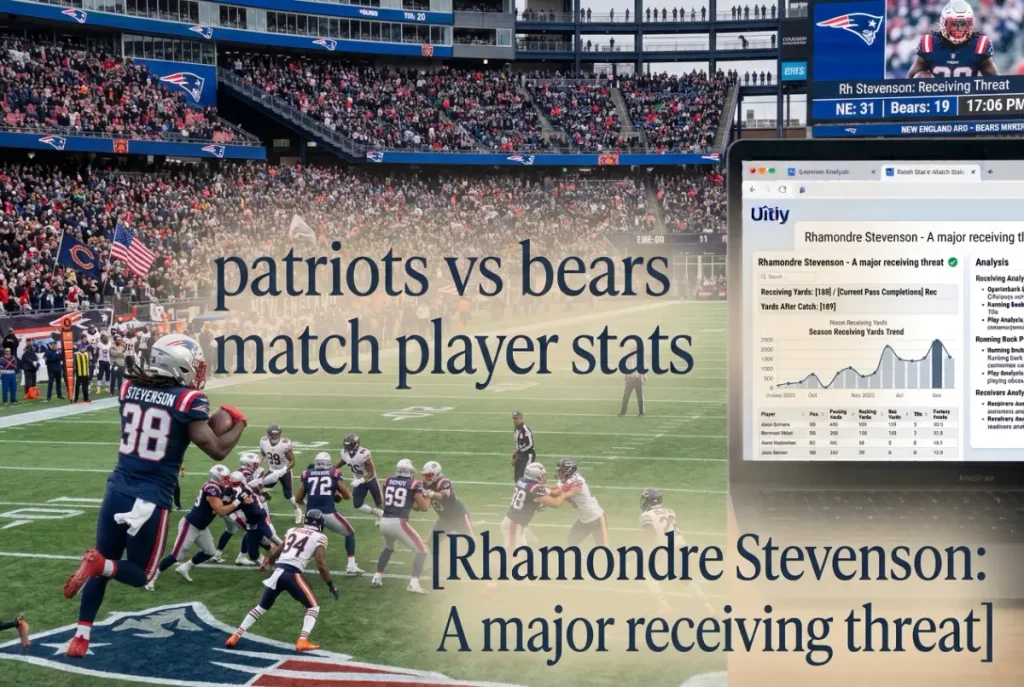
Rhamondre Stevenson: A major receiving threat
Stevenson was one of New England’s most effective offensive weapons. He caught five passes for 93 yards and one touchdown, including the impressive 48-yard scoring reception just before halftime.
His receiving production was particularly valuable because Chicago limited the Patriots’ traditional running game. Stevenson finished with 22 rushing yards on six carries, giving him 115 yards from scrimmage.
His ability to contribute as both a runner and receiver made him difficult to ignore. New England used him to gain yards after the catch and create a scoring opportunity when the offense needed a spark.
Stevenson’s performance was a positive takeaway for the Patriots, even though it was not enough to overcome Chicago’s lead.
Hunter Henry: Reliable production at tight end
Hunter Henry recorded seven receptions for 71 yards, making him one of Maye’s most dependable targets.
His reception total demonstrated the value of a reliable tight end in an offense that needed to move the chains. Henry helped New England complete shorter passes and keep drives moving when deeper opportunities were less available.
Although he did not score a touchdown, his contribution was significant. His seven catches tied him for the highest reception total among the Patriots’ listed receivers and tight ends in the game.
Eli Raridon: A third-quarter touchdown
Eli Raridon caught three passes for 56 yards and scored a 30-yard touchdown in the third quarter.
The touchdown came after Chicago had extended its advantage to 27–14. Raridon’s score helped New England respond and cut the deficit to six points at 27–21.
His performance showed that the Patriots could find scoring opportunities beyond their most established offensive options. The 30-yard touchdown was one of the key moments that kept the contest competitive.
Other Patriots contributors
A.J. Brown finished with three catches for 48 yards, while DeMario Douglas added three receptions for 23 yards. Efton Chism III caught one pass for 16 yards.
TreVeyon Henderson contributed nine rushing yards and two receptions for 14 yards. The Patriots’ offense had several players involved, but the team needed to turn more of its opportunities into points to complete the comeback.
3. Bears Player Stats: Top Performers
Chicago’s offensive production came from a combination of efficient quarterback play, a productive rushing attack, and explosive receiving plays.
| Bears player | Passing | Rushing | Receiving |
|---|---|---|---|
| Caleb Williams | 308 yards, 2 TD, 0 INT | 18 yards | — |
| D’Andre Swift | — | 78 yards, 1 TD | 4 catches, 12 yards |
| Luther Burden III | — | 7 yards | 4 catches, 130 yards, 1 TD |
| Rome Odunze | — | — | 4 catches, 69 yards |
| Colston Loveland | — | — | 7 catches, 69 yards, 1 TD |
| Cole Kmet | — | — | 3 catches, 28 yards |
| Roschon Johnson | — | 13 yards | — |
Source: Pro-Football-Reference game box score.
Luther Burden III: Chicago’s biggest receiving threat
Luther Burden III delivered one of the most impressive individual performances of the night. He caught four passes for 130 yards and a touchdown, averaging 32.5 yards per reception.
His biggest contribution came on a 24-yard touchdown reception from Williams with just 14 seconds remaining in the first half. That score pushed Chicago’s lead to 20–7 before New England responded with its own touchdown.
Burden’s 130 receiving yards gave the Bears a major downfield threat. Even with only four receptions, he produced substantial yardage and helped Chicago stretch the Patriots’ defense.
For Bears fans, his performance was one of the clearest highlights of the victory. It also demonstrated how an explosive receiver can change a game without needing a high number of targets.
D’Andre Swift: The ground-game leader
D’Andre Swift led Chicago’s rushing attack with 22 carries for 78 yards and one touchdown. He also caught four passes for 12 yards, finishing with 90 yards from scrimmage.
Swift scored on a four-yard run in the first quarter, helping the Bears establish an early 10–0 lead. That opening advantage mattered because Chicago was able to remain in front for the rest of the game.
While his average of 3.5 yards per carry was not especially explosive, Swift provided consistent work and helped Chicago maintain possession. His 22 carries also allowed the Bears to keep pressure off Williams and balance the offense.
Swift’s role became especially important in the fourth quarter, when Chicago focused on sustaining drives and limiting New England’s remaining opportunities.
Colston Loveland: A key touchdown reception
Colston Loveland caught seven passes for 69 yards and a touchdown. His 12-yard scoring reception in the third quarter helped Chicago increase its lead to 27–14.
Loveland’s seven catches tied him with Henry for the highest reception total among the players highlighted in this matchup. He provided Williams with a dependable option over the middle and helped the Bears convert passing opportunities into meaningful gains.
His touchdown was also well timed. After New England had narrowed Chicago’s lead before halftime, the Bears needed a response to prevent the Patriots from gaining control of the game.
Rome Odunze and Cole Kmet
Rome Odunze finished with four receptions for 69 yards. His contributions included important catches that helped Chicago maintain possession and move the chains during key drives.
Cole Kmet added three receptions for 28 yards. While his production was more modest than Burden’s, Kmet gave Williams another passing option and helped distribute the workload across Chicago’s receiving group.
Together, these players helped prevent New England’s defense from focusing entirely on Burden or Loveland.
4. Team Stats: Patriots vs Bears Comparison
The final score tells only part of the story. Both offenses moved the ball effectively, but Chicago performed better in several situations that had a direct impact on the outcome.
| Team statistic | Patriots | Bears |
|---|---|---|
| Final score | 24 | 30 |
| Passing yards | 321 | 308 |
| Rushing yards | 70 | 116 |
| First downs | 20 | 21 |
| Third-down conversions | 2 of 7 | 4 of 12 |
| Turnovers | 1 | 0 |
| Penalties | 10 | 9 |
| Penalty yards | 71 | 69 |
| Time of possession | 27:36 | 32:24 |
Team totals and individual statistics may vary slightly across published box-score displays. The passing and rushing figures above follow the detailed game statistics; possession, penalties, and first downs are reported in the game coverage.
Total offense and passing yards
The Patriots’ passing attack generated 321 yards, compared with 308 for Chicago. Maye was productive through the air, and New England finished with several important long receptions.
Chicago, however, paired its passing production with a stronger rushing performance. Swift’s 78 yards and touchdown gave the Bears a more balanced offensive attack.
The result was a game in which New England could move the ball but could not consistently turn its offensive progress into enough points to take the lead.
Rushing advantage
The Bears gained 116 rushing yards, while the Patriots finished with 70. That 46-yard difference helped Chicago control the pace and maintain possession during important stretches.
Swift’s workload was a major reason for the gap. Chicago used the running game to support Williams, keep the defense guessing, and make it more difficult for New England to predict the next play.
Maye’s 26 rushing yards helped the Patriots, but New England’s running backs were held to relatively limited production.
Turnovers and possession
One of the most important differences was ball security. Chicago finished without a turnover, while New England lost possession once on Maye’s end-zone interception.
The Bears also held the ball for 32 minutes and 24 seconds, nearly five minutes longer than the Patriots. That advantage became especially valuable late in the game, when Chicago needed to prevent New England from getting another meaningful possession.
Third-down and fourth-down execution
Both teams had opportunities to extend drives, but Chicago converted important situations when it mattered.
The Bears converted both of their fourth-down attempts, while the Patriots failed on their only fourth-down try, according to the postgame statistical breakdown. Those plays helped Chicago keep drives alive and protect its advantage.
The broader lesson is that yardage alone does not determine a football game. Chicago combined its offensive production with better ball security and timely conversions.
5. Quarter-by-Quarter Scoring Summary
The game featured scoring in every quarter, but the Bears’ early advantage proved difficult for New England to erase.
| Quarter | Patriots | Bears | Key moment |
|---|---|---|---|
| First | 0 | 10 | Swift’s rushing touchdown and a Santos field goal |
| Second | 14 | 10 | Burden scores for Chicago; Stevenson answers for New England |
| Third | 7 | 7 | Loveland and Raridon exchange touchdowns |
| Fourth | 3 | 3 | Santos hits a 58-yard field goal |
| Final | 24 | 30 | Chicago wins by six |
Scoring sequence: Pro-Football-Reference.
First quarter: Chicago takes control
Chicago opened the scoring with a 43-yard field goal by Cairo Santos. Swift later added a four-yard rushing touchdown, putting the Bears ahead 10–0.
New England struggled to generate points during the opening quarter. Chicago’s defense made it difficult for the Patriots to turn their early possessions into a scoring response.
Second quarter: Both offenses find momentum
Maye put New England on the board with a seven-yard rushing touchdown. Santos then kicked a 31-yard field goal for Chicago.
Late in the half, Williams threw a 24-yard touchdown pass to Burden, extending Chicago’s advantage to 20–7. The Patriots responded immediately before halftime when Maye connected with Stevenson for a 48-yard touchdown.
That late score made it 20–14 and kept the Patriots within striking distance.
Third quarter: Touchdowns keep the game close
Williams found Loveland for a 12-yard touchdown, extending Chicago’s lead to 27–14.
New England answered when Maye connected with Raridon for a 30-yard touchdown. The score brought the Patriots within 27–21, setting up a tense final quarter.
Fourth quarter: Santos delivers the decisive kick
Santos missed a 53-yard field-goal attempt earlier in the fourth quarter, but he had another opportunity late in the game.
With 1:34 remaining, he converted a 58-yard field goal to make it 30–21. The kick was reported as a career long and gave Chicago a nine-point cushion.
New England continued fighting and added a 47-yard field goal with 37 seconds left, cutting the score to 30–24.
The Patriots then attempted an onside kick, but Chicago recovered it. That recovery ended New England’s final realistic opportunity to tie the game.
6. Key Takeaways From the Patriots-Bears Matchup
Chicago won the turnover battle
The Bears’ clean performance with the football was one of the most important factors in the result. Maye’s interception in the end zone denied New England a scoring opportunity, while Williams avoided turnovers.
Against two productive offenses, that difference proved significant.
Big plays changed the momentum
Burden’s 130 receiving yards and touchdown gave Chicago a major downfield weapon. Stevenson’s 48-yard touchdown reception and Raridon’s 30-yard scoring catch helped New England stay competitive.
Both teams produced explosive plays, but Chicago made its early scoring advantage count.
The Bears controlled the closing minutes
Chicago’s possession advantage helped it manage the fourth quarter. Rather than giving the Patriots repeated chances to take the lead, the Bears kept the offense on the field and eventually created the opportunity for Santos’ long field goal.
New England showed offensive promise
Maye’s 321 passing yards, three total touchdowns, and strong completion percentage were encouraging signs for the Patriots. Stevenson’s receiving production and Raridon’s touchdown also showed that the offense could create scoring opportunities through different players.
However, New England will need to improve its ball security and running-game consistency to turn similar performances into wins.
7. Live Game Box Score and Match Details
Thursday Night Football
Soldier Field • Chicago, IL
Patriots
4-3
24
Final
Oct 22
30
Bears
5-2
OverviewTeam StatsPlayer StatsPlay-By-Play
Use the game details above to review the matchup and its available scoring and player statistics.
8. Frequently Asked Questions
Who won the Patriots vs Bears game on October 22, 2026?
The Chicago Bears defeated the New England Patriots 30–24 at Soldier Field in Week 7 of the 2026 NFL regular season. Chicago built an early lead and held on despite New England’s late scoring attempt.
What were the key patriots vs bears match player stats?
Caleb Williams completed 22 of 33 passes for 308 yards, two touchdowns, and no interceptions. Drake Maye completed 24 of 31 passes for 321 yards, two passing touchdowns, one interception, and one rushing touchdown. Luther Burden III led Chicago with 130 receiving yards, while Rhamondre Stevenson recorded 93 receiving yards and a touchdown for New England.
How many passing yards did Caleb Williams have?
Williams threw for 308 yards and two touchdowns. He completed 22 passes on 33 attempts and did not throw an interception.
How many passing yards did Drake Maye have?
Maye recorded 321 passing yards, completing 24 of 31 attempts. He threw two touchdown passes and one interception and added a rushing touchdown.
Who was the leading receiver in the game?
Luther Burden III was the leading receiver by yardage. The Bears wide receiver caught four passes for 130 yards and one touchdown. His average of 32.5 yards per reception highlighted his impact on Chicago’s passing attack.
How many touchdowns did Drake Maye score?
Maye accounted for three total touchdowns: two passing touchdowns and one rushing touchdown. His scores helped keep New England competitive, although the Patriots could not overcome Chicago’s lead.
How did D’Andre Swift perform?
Swift rushed 22 times for 78 yards and one touchdown. He also caught four passes for 12 yards, giving him 90 total yards from scrimmage.
What was the final score by quarter?
Chicago scored 10 points in the first quarter, 10 in the second, seven in the third, and three in the fourth. New England scored zero, 14, seven, and three points across those quarters, respectively.
Why did the Bears win?
Chicago benefited from a balanced offensive attack, a rushing advantage, zero turnovers, and a decisive 58-yard field goal from Santos. Recovering New England’s late onside kick helped the Bears secure the victory.
9. Final Verdict
The Patriots and Bears produced a competitive game with strong quarterback performances and several memorable scoring plays. Maye threw for more yards, but Williams protected the football and helped Chicago take advantage of its opportunities.
Burden’s explosive receiving performance, Swift’s contribution on the ground, and Santos’ late field goal were central to the Bears’ victory. For New England, Stevenson’s receiving numbers and Maye’s three total touchdowns offered encouraging signs despite the defeat.
For readers analyzing patriots vs bears match player stats, the most important takeaway is that Chicago won through a combination of explosive passing plays, a stronger rushing attack, and better ball security. New England had enough offensive production to challenge the Bears, but a costly interception and Chicago’s late-game execution made the difference.
The 30–24 result gave Chicago a valuable Week 7 win and left the Patriots with areas to improve before their next matchup.
1 thought on “Patriots vs Bears Match Player Stats: (2026)”