The los angeles chargers vs new york giants match player stats and New York Giants delivered an exciting NFL contest on September 28, 2025, at MetLife Stadium in East Rutherford, New Jersey. The Giants secured a 21–18 victory, earning their first win of the 2025 regular season after a difficult start.
The game featured two different offensive approaches. Los Angeles produced explosive rushing plays and more total yards, while New York relied on quarterback Jaxson Dart’s dual-threat ability, timely scoring drives, and important defensive takeaways.
For fans researching los angeles chargers vs new york giants match player stats, the final score only tells part of the story. Justin Herbert threw for 203 yards and one touchdown, but two interceptions hurt the Chargers. Rookie quarterback Jaxson Dart finished with 111 passing yards, one passing touchdown, 54 rushing yards, and a rushing touchdown.
Running back Omarion Hampton was one of the game’s biggest offensive stars. He rushed for 128 yards and a touchdown on just 12 carries, averaging 10.7 yards per attempt. Wide receiver Quentin Johnston also contributed eight catches for 98 yards and a touchdown.
Despite Los Angeles generating more total offense, New York made better use of important opportunities and protected its lead in the fourth quarter. Here is a detailed breakdown of the player statistics, team numbers, scoring plays, and key lessons from the game.
1. Match Summary and Final Score
The Giants entered the game looking for their first win of the season, while the Chargers arrived with a 3–0 record. New York’s victory was significant because it showed that a team could win through situational execution even when its opponent produced more offensive yardage.
Los Angeles finished with 338 total yards, compared with 250 for New York. However, the Giants benefited from two interceptions and controlled possession for more than 35 minutes.
The final score reflected the importance of protecting the football, sustaining drives, and converting opportunities into points.
2. Justin Herbert Passing Stats
Justin Herbert led the Chargers’ passing attack throughout the game. He completed 23 of 41 attempts for 203 yards and one touchdown.
His passing production helped Los Angeles remain competitive, but two interceptions proved costly. Herbert also took two sacks for a loss of 17 yards.
Justin Herbert’s official passing numbers
| Statistic | Result |
|---|---|
| Completions | 23 |
| Passing attempts | 41 |
| Completion percentage | 56.1% |
| Passing yards | 203 |
| Passing touchdowns | 1 |
| Interceptions | 2 |
| Sacks taken | 2 |
| Yards lost on sacks | 17 |
| Longest completion | 36 yards |
| Passer rating | 57.3 |
Herbert’s biggest scoring connection came on a 36-yard touchdown pass to Quentin Johnston. The play helped the Chargers close the gap before halftime and demonstrated their ability to create explosive gains through the air.
However, the interceptions changed the game’s momentum. Turnovers can be particularly damaging when an offense is moving the ball effectively because they end drives without giving the team an opportunity to finish with points.
Herbert’s 203 passing yards were respectable, but his two interceptions reduced the value of that production. The performance demonstrates why quarterback evaluation should include efficiency, ball security, and scoring rather than passing yards alone.
3. Jaxson Dart Passing and Rushing Stats
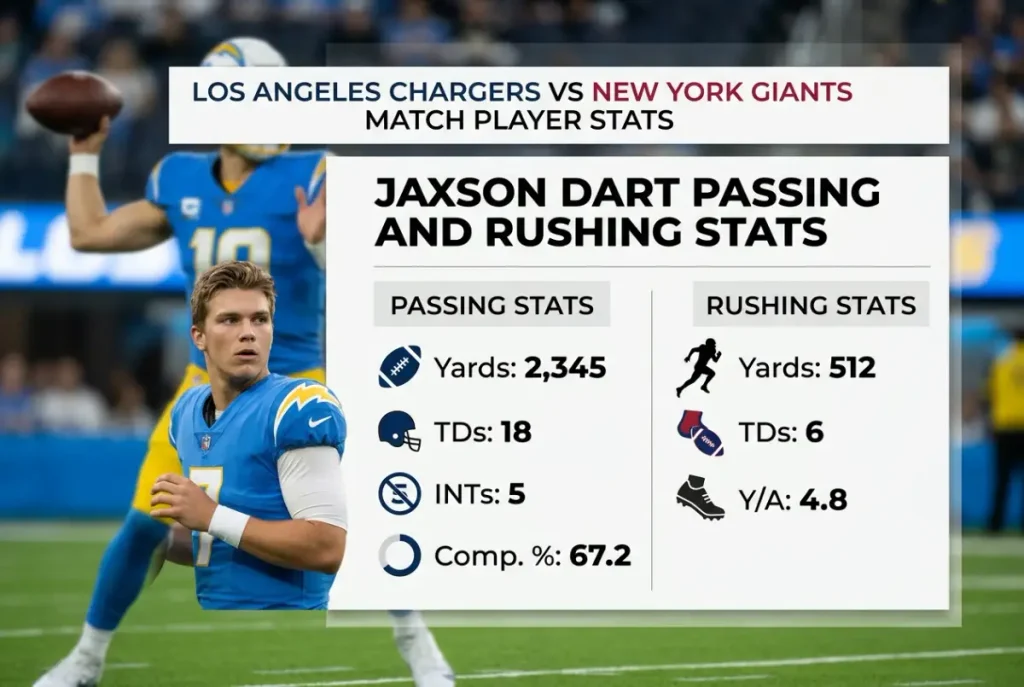
Jaxson Dart made his first NFL start in this game and helped the Giants secure their first victory of the season.
The rookie quarterback completed 13 of 20 passes for 111 yards, one touchdown, and no interceptions. He also rushed for 54 yards and scored a rushing touchdown.
Jaxson Dart’s player statistics
| Statistic | Result |
|---|---|
| Completions | 13 |
| Passing attempts | 20 |
| Completion percentage | 65.0% |
| Passing yards | 111 |
| Passing touchdowns | 1 |
| Interceptions | 0 |
| Sacks taken | 5 |
| Yards lost on sacks | 25 |
| Longest completion | 18 yards |
| Passer rating | 96.0 |
| Rushing yards | 54 |
| Rushing touchdowns | 1 |
Dart opened the scoring with a 15-yard rushing touchdown. His ability to run gave the Chargers’ defense another threat to consider, making it more difficult to focus entirely on the passing game.
He later connected with tight end Theo Johnson for a three-yard touchdown pass in the third quarter. That score gave New York a 21–10 lead before the Chargers responded with a long touchdown run.
Dart was sacked five times, showing that Los Angeles still created pressure. Nevertheless, he avoided interceptions and contributed two touchdowns.
His performance was not built on a large passing-yardage total. Instead, it came from timely decisions, mobility, and his ability to capitalize on scoring opportunities.
4. Omarion Hampton Rushing Stats
Omarion Hampton was arguably the standout offensive player for Los Angeles.
The Chargers running back finished with 128 rushing yards and one touchdown on 12 carries. His average of 10.7 yards per carry reflected his ability to turn running opportunities into substantial gains.
Omarion Hampton’s rushing performance
| Statistic | Result |
|---|---|
| Rushing attempts | 12 |
| Rushing yards | 128 |
| Average yards per carry | 10.7 |
| Rushing touchdowns | 1 |
| Longest run | 54 yards |
| Receptions | 5 |
| Receiving yards | 37 |
Hampton’s biggest moment came in the third quarter when he broke free for a 54-yard touchdown run. The play brought Los Angeles within three points and gave the Chargers a realistic opportunity to take control.
He also contributed five receptions for 37 yards, providing Herbert with another option in the passing game.
His combined rushing and receiving production highlighted his versatility. When a running back can create explosive gains on the ground and contribute as a receiver, the offense becomes harder to defend.
Despite Hampton’s outstanding performance, the Chargers could not overcome their turnovers and close the remaining scoring gap. His individual success was one of the clearest examples of the difference between winning a statistical category and winning the game.
5. Quentin Johnston Receiving Stats
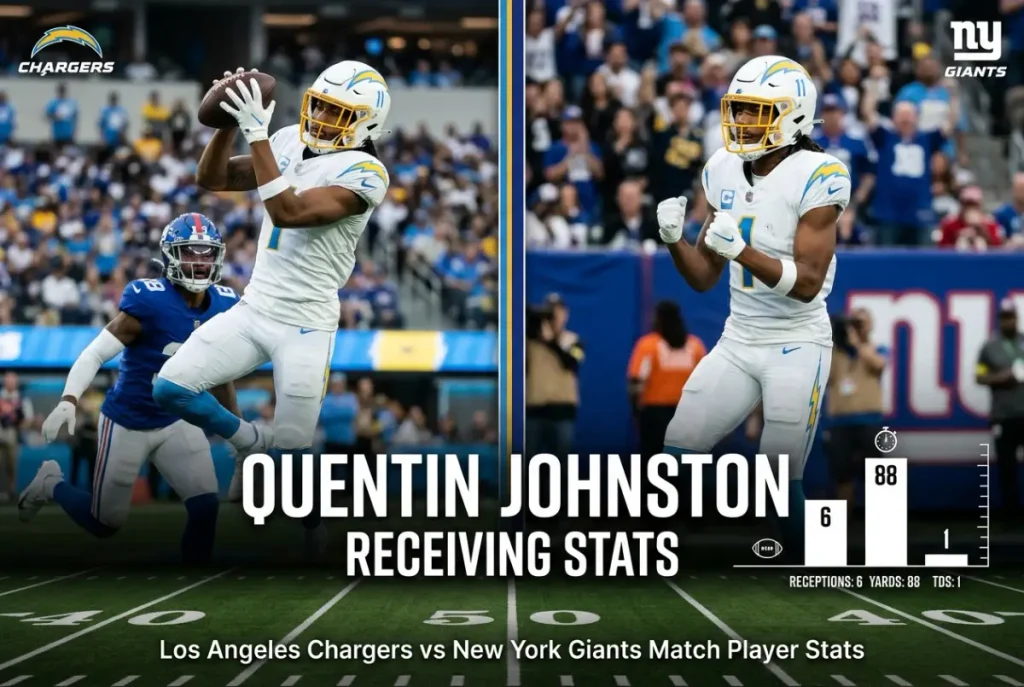
Quentin Johnston led the Chargers in receiving yards and provided the team’s most important passing touchdown.
He caught eight passes on 13 targets for 98 yards and one touchdown. His longest reception was the 36-yard scoring play from Herbert.
Quentin Johnston’s receiving numbers
| Statistic | Result |
|---|---|
| Targets | 13 |
| Receptions | 8 |
| Receiving yards | 98 |
| Average yards per reception | 12.3 |
| Receiving touchdowns | 1 |
| Longest reception | 36 yards |
Johnston’s performance gave the Chargers a reliable source of offensive production. His ability to gain yards after securing the football helped Los Angeles move the chains and create scoring opportunities.
The touchdown connection with Herbert was especially important because it reduced the deficit and kept the game competitive.
However, receiving production must be considered alongside the final result. Even when a wide receiver gains close to 100 yards, the offense still needs to protect the ball, convert third downs, and finish drives.
Johnston delivered a productive individual performance, but the Chargers needed more overall efficiency to turn that production into a victory.
6. Other los angeles chargers vs new york giants match player stats
Several other Chargers contributed to the passing game, although Johnston was the leading receiver.
| Player | Receptions | Receiving yards | Touchdowns |
|---|---|---|---|
| Keenan Allen | 5 | 37 | 0 |
| Omarion Hampton | 5 | 37 | 0 |
| Oronde Gadsden | 2 | 16 | 0 |
| Ladd McConkey | 1 | 11 | 0 |
| Tyler Conklin | 1 | 3 | 0 |
Keenan Allen offered Herbert a shorter-route option, while Hampton added value through his work as a receiving back.
Oronde Gadsden and Ladd McConkey also contributed catches, but neither matched Johnston’s overall receiving production.
The distribution of targets shows that Los Angeles had several players involved in the passing attack. The challenge was converting those opportunities into enough points to overcome the Giants’ lead.
7. New York Giants Rushing and Receiving Performance
The Giants used a combination of quarterback mobility and running-back involvement to keep their offense moving.
Dart’s 54 rushing yards and touchdown were especially important because his running ability forced the Chargers to account for him outside the pocket.
Cam Skattebo also played a major role in New York’s rushing attack. He finished with 79 rushing yards on 25 carries, according to the game’s published statistical summaries.
Key Giants offensive contributions
| Player | Key contribution |
|---|---|
| Jaxson Dart | 111 passing yards, one passing TD, 54 rushing yards, one rushing TD |
| Cam Skattebo | 79 rushing yards on 25 carries |
| Theo Johnson | Three-yard receiving touchdown |
| Giants running game | Helped New York control possession and sustain drives |
The Giants’ offensive approach was not as explosive as Los Angeles’ in terms of total yardage. However, consistent rushing attempts helped New York control the clock and reduce the number of possessions available to the Chargers.
Dart’s mobility added a second dimension to the running game, while Johnson’s touchdown reception supplied a crucial third-quarter score.
For New York, the key was not producing the biggest individual statistical totals. It was combining enough offensive production with timely scoring and defensive stops to protect the lead.
8. Team Statistics Comparison
The overall team statistics reveal why the Chargers’ defeat was surprising at first glance.
| Team statistic | Chargers | Giants |
|---|---|---|
| Final score | 18 | 21 |
| Total yards | 338 | 250 |
| Rushing yards | 152 | 161 |
| Net passing yards | 186 | 89 |
| Third-down conversions | — | 7 of 15 |
| Time of possession | — | 35:28 |
| Interceptions thrown | 2 | 0 |
The Chargers produced more total yards and net passing yards, but the Giants gained more rushing yards and controlled possession for longer.
New York’s seven successful third-down conversions helped the offense sustain drives and limit the Chargers’ opportunities to respond.
The two interceptions thrown by Los Angeles were another important difference. Even when an offense produces more yards, turnovers can prevent it from converting that production into points.
This game is a useful reminder that NFL outcomes are determined by a combination of yardage, efficiency, possession, and turnovers rather than one statistic alone.
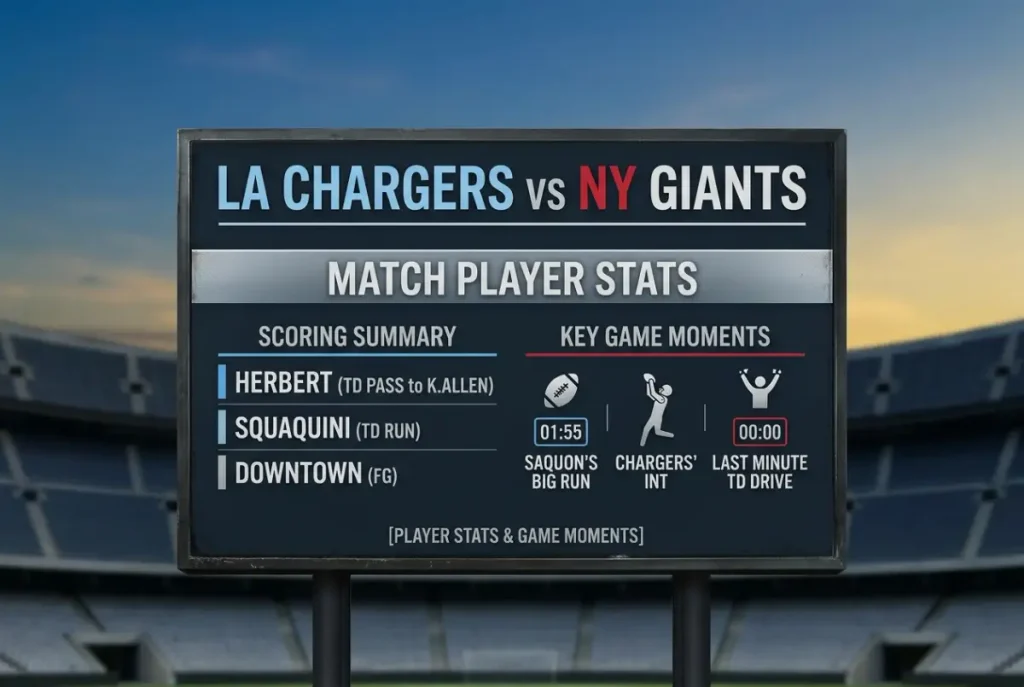
9. Scoring Summary and Key Game Moments
The Giants built their lead through a combination of quarterback rushing, passing touchdowns, and field goals.
First quarter
Dart opened the scoring with a 15-yard rushing touchdown. The Giants established an early advantage and put pressure on the Chargers to respond.
New York added points through its kicking game, helping build a lead while its defense attempted to limit Los Angeles’ explosive offense.
Second quarter
The Chargers found an important scoring opportunity when Herbert connected with Johnston for a 36-yard touchdown.
The play demonstrated Los Angeles’ ability to strike quickly through the air, keeping the contest close before halftime.
Third quarter
The Giants extended their lead with Dart’s three-yard touchdown pass to Theo Johnson.
Hampton answered with a spectacular 54-yard rushing touchdown for the Chargers. Herbert then ran for the two-point conversion, bringing Los Angeles within three points at 21–18.
Fourth quarter
Neither team scored in the final quarter.
The Giants’ defense protected the narrow lead, while the Chargers could not produce the additional points needed to complete a comeback.
The fourth quarter ultimately decided the result. New York did enough to preserve its advantage, while Los Angeles was unable to turn its offensive production into another scoring drive.
10. Why the Giants Won Despite Fewer Total Yards
The Giants’ victory provides an excellent example of how situational football can outweigh total offensive yardage.
First, New York avoided interceptions. Dart completed 13 passes without throwing a pick, while Herbert threw two interceptions.
Second, the Giants controlled possession for 35 minutes and 28 seconds. Longer drives can reduce an opponent’s opportunities and give the defense additional recovery time.
Third, New York converted seven of 15 third-down attempts. Those conversions helped the offense maintain possession and avoid repeatedly giving the ball back to Los Angeles.
Fourth, the Giants made their scoring opportunities count. They built a 21-point total through timely touchdowns and field goals, then prevented the Chargers from scoring in the fourth quarter.
Finally, New York’s defense managed the game’s closing stages effectively. The Chargers had enough offensive talent to threaten a comeback, but they could not complete it.
These factors explain why a team can win with fewer total yards. Efficiency, turnovers, and clock management are often just as important as explosive offensive production.
11. Fantasy Football Takeaways
The game also offers several lessons for fantasy football managers.
Omarion Hampton: His 128 rushing yards and one rushing touchdown made him a major contributor. His five receptions for 37 yards added further value in formats that reward catches.
Quentin Johnston: Eight receptions, 98 yards, and one touchdown gave Johnston a productive receiving line.
Justin Herbert: His passing yards and touchdown provided some value, but the two interceptions hurt his overall performance, particularly in leagues that penalize turnovers.
Jaxson Dart: Dart’s combination of passing and rushing production was important. His 54 rushing yards and rushing touchdown added value beyond his passing statistics.
Fantasy managers should remember that a single game is only one part of a player’s evaluation. Future decisions should also consider weekly workload, opponent strength, injuries, and current role in the offense.
12. Frequently Asked Questions
What was the final score of the Chargers vs Giants game?
The New York Giants defeated the Los Angeles Chargers 21–18 on September 28, 2025, at MetLife Stadium.
How did Justin Herbert perform?
Herbert completed 23 of 41 passes for 203 yards, one touchdown, and two interceptions. He also rushed for 24 yards.
How many rushing yards did Omarion Hampton record?
Hampton rushed for 128 yards and one touchdown on 12 carries. He averaged 10.7 yards per carry and recorded a long run of 54 yards.
How did Jaxson Dart perform in his first NFL start?
Dart completed 13 of 20 passes for 111 yards and one touchdown without an interception. He also rushed for 54 yards and scored a rushing touchdown.
Who was the Chargers’ leading receiver?
Quentin Johnston led the Chargers with eight receptions for 98 yards and one touchdown.
Why did the Giants win?
New York benefited from two interceptions thrown by Herbert, strong possession control, timely touchdowns, and a defense that held the Chargers scoreless in the fourth quarter.
Where can I find the official box score?
Fans can review the official NFL game center and the published NFL box score PDF for individual statistics and game details.
Conclusion
The los angeles chargers vs new york giants match player stats show how different approaches can shape an NFL game. Los Angeles generated more total yards and produced the contest’s most explosive rushing performance through Omarion Hampton. Quentin Johnston also delivered a strong receiving performance, while Justin Herbert helped the offense move the ball through the air.
New York, however, made better use of key opportunities. Jaxson Dart contributed through both passing and rushing, the Giants controlled possession, and their defense protected a three-point lead in the fourth quarter.
The final 21–18 score demonstrates that total yardage does not always determine the winner. Turnovers, third-down efficiency, red-zone execution, and clock management can be equally important.
For NFL fans and fantasy football readers, this game remains a useful example of why player statistics should be analyzed alongside team performance and game context. Looking beyond the final score provides a much clearer understanding of how the Giants earned their victory over the Chargers.
1 thought on “Los Angeles Chargers vs New York Giants Match Player Stats (2026)”