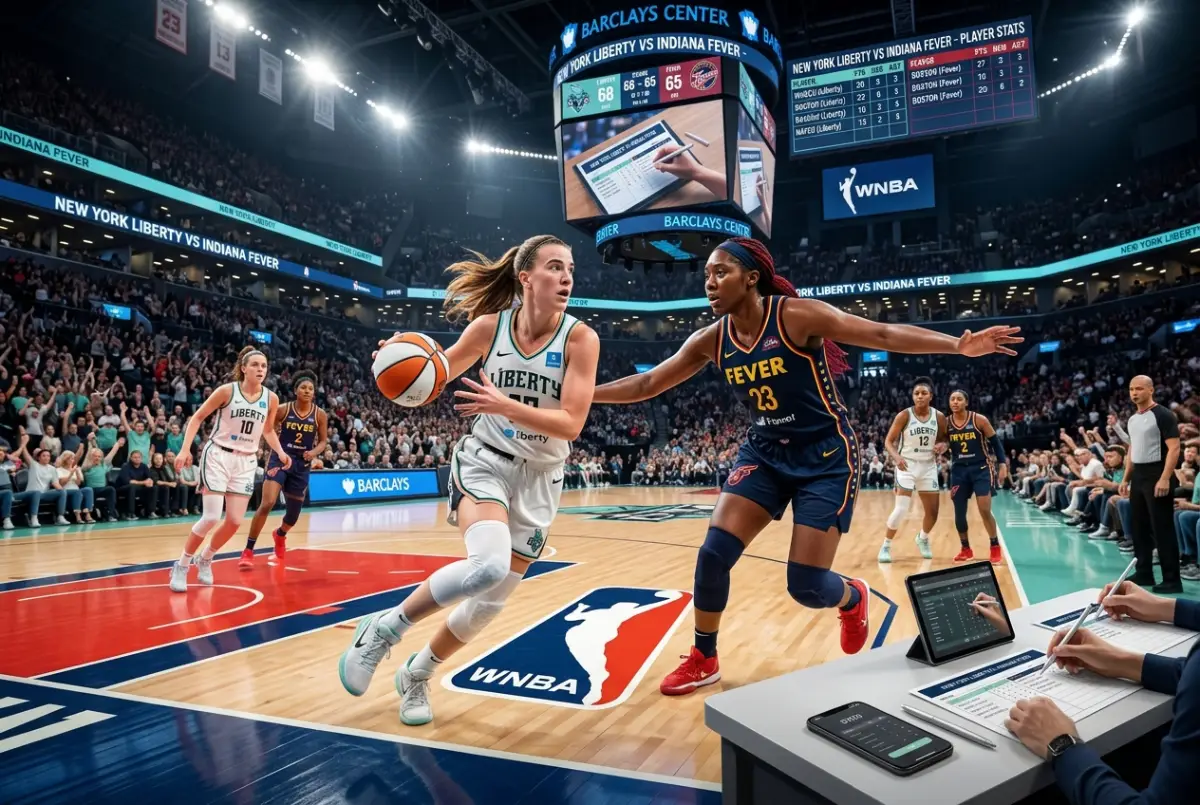
The latest matchup provides an exciting look at two competitive WNBA teams. On August 22, 2026, the New York Liberty defeated the Indiana Fever 109–102 at Barclays Center in Brooklyn. Breanna Stewart led New York with 22 points, while Leonie Fiebich added 20 points in her return from a foot injury. Indiana stayed in contention behind strong performances from Kelsey Mitchell, Aliyah Boston, and Caitlin Clark.
This article examines the new york liberty vs indiana fever match player stats, including the leading scorers, team statistics, quarter-by-quarter results, key moments, and the performances that shaped the final score. It also explains how to interpret the box score and which statistics matter most when comparing these teams.
New York Liberty
Home team · Brooklyn, New York
109 points
Indiana Fever
Away team · Indianapolis, Indiana
102 points
Final score
Liberty won by 7
Game date: August 22, 2026 · Venue: Barclays Center, Brooklyn
1. Game Summary: New York Liberty vs Indiana Fever
The August 22 contest was a high-scoring game in which both teams produced strong offensive stretches. New York ultimately held on for a seven-point victory after Indiana mounted a late challenge.
The Liberty scored 33 points in the first quarter and carried a four-point lead into halftime. They then produced 32 points in the third quarter, creating enough separation to withstand Indiana’s fourth-quarter push.
The Fever did not go quietly. Their offense kept generating scoring opportunities, and Kelsey Mitchell’s three-pointer with 1:44 remaining tied the game at 100. New York responded with crucial plays from Stewart and Fiebich before Pauline Astier made two free throws late in the game.
The result demonstrated how important late-game execution can be. Indiana had the ability to score with New York, but the Liberty made the plays needed to regain control during the final minute.
Final score by quarter
| Quarter | Indiana Fever | New York Liberty |
|---|---|---|
| First | 26 | 33 |
| Second | 23 | 20 |
| Third | 29 | 32 |
| Fourth | 24 | 24 |
| Final | 102 | 109 |
Points scored by quarter
Quarter-by-quarter scoring in the August 22, 2026 WNBA matchup.
Indiana Fever
New York Liberty
09182736Q1Q2Q3Q4
The chart highlights New York’s advantage in the opening and third quarters. Indiana won the second quarter by three points, while the teams scored equally in the fourth.
The Liberty’s seven-point final advantage came from winning two quarters by a combined 10 points and limiting the damage in the other two. Indiana’s comeback made the finish competitive, but New York’s late execution proved decisive.
2. New York Liberty Player Stats
The Liberty received important contributions from several players, led by Stewart, Fiebich, and Jonquel Jones.
| Player | Points | Rebounds | Key contribution |
|---|---|---|---|
| Breanna Stewart | 22 | — | Scoring and late-game execution |
| Leonie Fiebich | 20 | — | Scoring in her return from injury |
| Jonquel Jones | 19 | 10 | Double-double performance |
A dash means the individual statistic was not confirmed in the cited game summary; it does not mean zero.
Breanna Stewart: 22 points
Stewart led New York with 22 points and played a major role in the Liberty’s ability to maintain offensive pressure.
Her scoring helped New York respond when Indiana threatened to take control. Stewart also contributed at the most important stage of the game, making a free throw after the score reached 100–100.
That point did not decide the contest by itself, but it helped New York move ahead in a tense closing sequence. In close basketball games, free throws can become especially valuable because they allow a team to score without needing to create another field-goal attempt.
Stewart’s performance showed why scoring leaders are judged not only by their total points but also by when they contribute.
Leonie Fiebich: 20 points
Fiebich scored 20 points in her first game since July 3, following a foot injury. Her return gave New York another productive option in its rotation.
Her contribution became especially important during the closing stretch. After Stewart’s free throw and an Indiana miss, Fiebich scored a basket and drew a foul with 57.5 seconds remaining. Although she missed the additional free throw, the play helped the Liberty create separation.
Fiebich also secured a rebound after Caitlin Clark missed a driving layup, helping New York maintain possession during the final minute.
A player returning from injury can influence a game through more than scoring. Rebounding, spacing, defensive positioning, and decision-making all help a team, particularly in high-pressure situations.
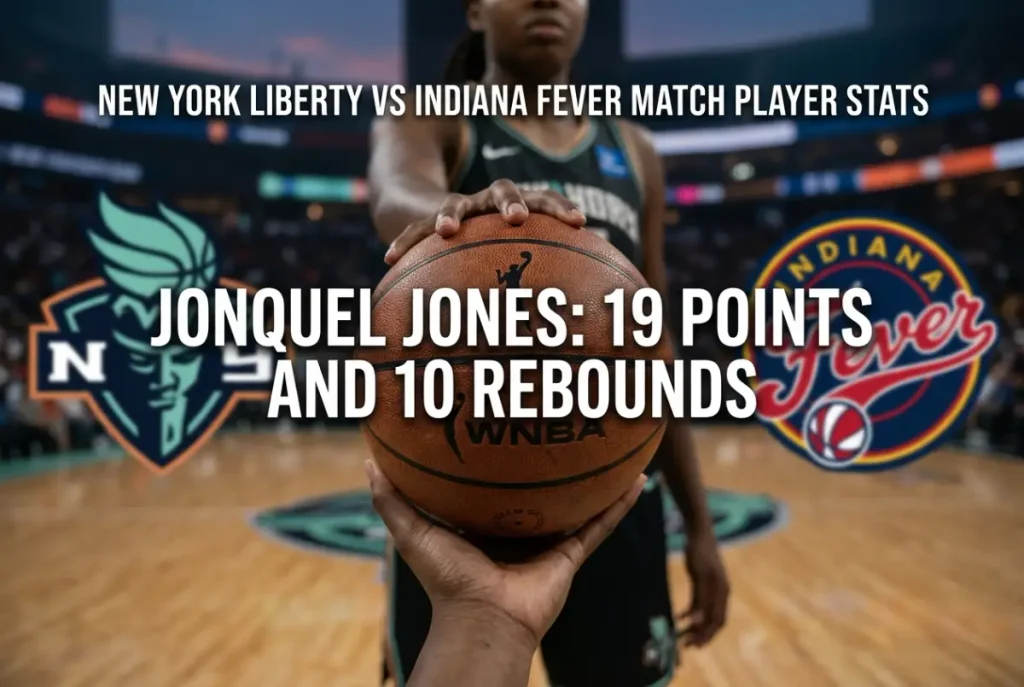
Jonquel Jones: 19 points and 10 rebounds
Jones recorded a double-double with 19 points and 10 rebounds. Her work around the basket provided New York with a strong interior presence.
Rebounding matters because it determines who controls missed shots. Offensive rebounds can create second-chance scoring opportunities, while defensive rebounds prevent opponents from extending possessions.
Jones also gives the Liberty a player who can score inside and make opponents adjust their defensive positioning. Her performance helped New York balance perimeter scoring with production closer to the basket.
The combination of Stewart’s scoring, Fiebich’s return, and Jones’s double-double gave the Liberty multiple offensive options rather than forcing one player to carry the entire attack.
3. Indiana Fever Player Stats
Indiana had three major scoring contributors: Kelsey Mitchell, Aliyah Boston, and Caitlin Clark. All three reached at least 20 points, but the Fever fell short in the final moments.
| Player | Points | Rebounds | Assists |
|---|---|---|---|
| Kelsey Mitchell | 25 | — | — |
| Aliyah Boston | 22 | — | — |
| Caitlin Clark | 21 | — | 8 |
The confirmed figures above are from the official WNBA game summary and associated game report. Unverified individual totals are left blank.
Kelsey Mitchell: 25 points
Mitchell was Indiana’s leading scorer with 25 points. Her ability to create offense from the perimeter kept the Fever competitive throughout the game.
One of her most important moments came late in the fourth quarter, when she made a three-pointer with 1:44 remaining to tie the score at 100. That shot gave Indiana a genuine opportunity to take control of the game.
Mitchell’s performance illustrates the value of perimeter scoring. A three-point basket can change the scoreboard quickly, especially when a team needs to overcome a small deficit.
However, making a late shot is only one part of closing out a game. The next defensive possession, rebounding, ball security, and free-throw execution can be equally important.
Indiana had the opportunity to win after Mitchell’s tying shot, but New York responded with better execution during the closing possessions.
Aliyah Boston: 22 points
Boston contributed 22 points, providing Indiana with a reliable scoring presence near the basket and in the team’s overall offensive structure.
A productive frontcourt player can help an offense remain balanced. When a team can score inside as well as outside, the opposing defense must defend more areas of the court.
Boston’s contribution also mattered because New York had its own strong interior scorer in Jones. Frontcourt production can influence rebounding opportunities, defensive matchups, and the amount of space available for perimeter players.
Even when a player scores efficiently, the team’s final result depends on how well all five players execute on both ends of the floor.
Caitlin Clark: 21 points and 8 assists
Clark finished with 21 points and eight assists, giving Indiana a combination of scoring and playmaking.
Points measure a player’s direct scoring contribution, while assists help show how often that player creates scoring opportunities for teammates. A guard who can do both makes the offense harder to defend because opponents must account for her own shot and her passing options.
Clark’s playmaking helped Indiana maintain its offensive production. However, one of the defining moments came late, when she missed a running layup after New York had moved ahead. Fiebich collected the rebound, helping the Liberty retain control.
The miss should be viewed in context rather than as a complete judgment of Clark’s performance. She scored 21 points and recorded eight assists, but the final possessions showed how quickly a close game can turn on a missed shot and a defensive rebound.
4. Team Statistics Comparison
The overall team numbers help explain how the game unfolded.
| Statistic | Indiana Fever | New York Liberty |
|---|---|---|
| Final points | 102 | 109 |
| Points in the paint | 46 | 52 |
| Fast-break points | 11 | 7 |
| Biggest lead | 2 | 10 |
| Bench points | 24 | 28 |
| Rebounds | 7* | 5* |
| Turnovers | 8 | 14 |
| Points off turnovers | 16 | 5 |
| Lead changes | 6 | — |
| Times tied | 7 | — |
*The listed rebound values are the figures shown in the official game’s abbreviated team summary and should not be interpreted as total rebounds. See the official box score for full rebound totals and other detailed statistics.
Scoring inside the paint
New York scored 52 points in the paint, compared with Indiana’s 46. This six-point difference reflects the Liberty’s ability to create scoring opportunities closer to the basket.
Interior scoring can come from post-ups, drives, cuts, offensive rebounds, and passes to players positioned near the rim. It can also create opportunities for outside shooters when defenders collapse toward the basket.
Indiana’s 46 paint points were still a substantial contribution. The difference was not that the Fever could not score inside; rather, New York produced more in that area.
Fast-break scoring
Indiana scored 11 fast-break points, while New York recorded seven. This gave the Fever a four-point advantage in transition scoring.
Fast breaks usually develop after defensive rebounds, steals, or other changes of possession. They can create easy scoring opportunities before the opposing defense gets organized.
However, transition points are only one component of offensive production. New York made up the difference through other scoring opportunities, particularly its greater production in the paint.
Bench production
The Liberty scored 28 bench points compared with Indiana’s 24. That four-point advantage suggests New York received useful scoring support beyond its leading contributors.
Bench performance is important over a long WNBA season because starters cannot play every minute. Substitutes must maintain the team’s energy, defend effectively, and take advantage of their opportunities.
The precise impact of bench players should be evaluated using minutes played, shooting efficiency, defensive contributions, and the timing of their scoring.
Turnovers and points off turnovers
Indiana committed eight turnovers, while New York committed 14. The Fever also scored 16 points off turnovers compared with five for the Liberty.
These numbers show that Indiana did a better job of converting New York’s mistakes into points. Yet the Fever still lost.
That is a useful reminder that no single category determines the final result. New York’s advantages in overall scoring and points in the paint helped offset Indiana’s stronger turnover-related production.
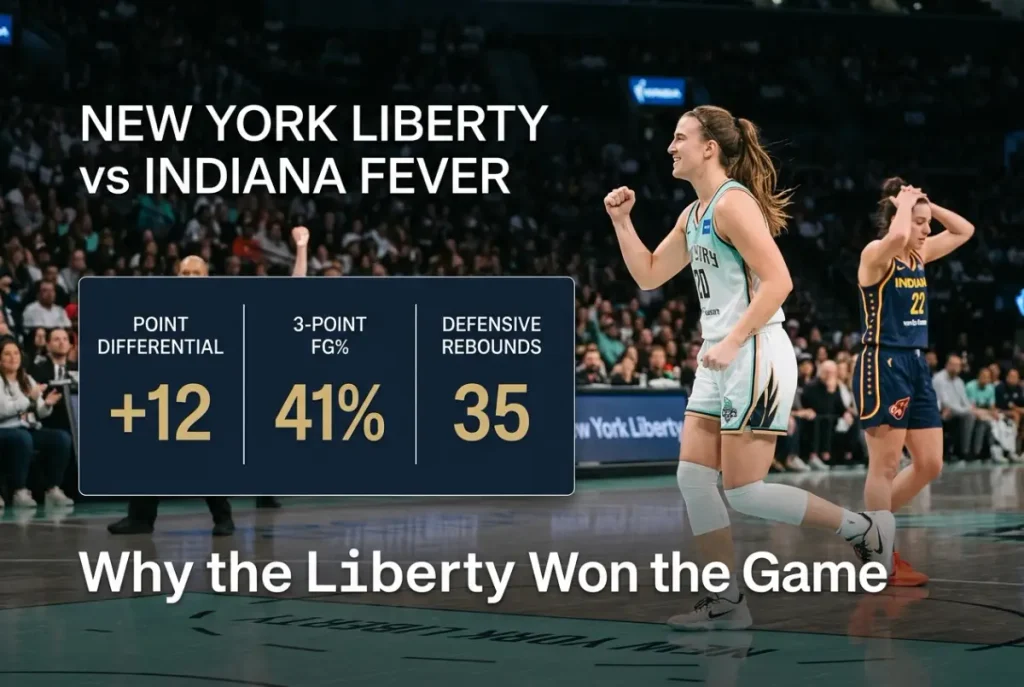
5. Why the Liberty Won the Game
New York’s seven-point win came from a combination of scoring balance, interior production, and execution under pressure.
First, the Liberty scored 109 points and produced 52 points in the paint. Their offense did not rely on one type of shot, giving Indiana several areas to defend.
Second, Fiebich’s return added another productive scorer. Her 20 points were particularly valuable because she made important plays during the closing stretch.
Third, Stewart and Jones supplied dependable production. Stewart led the team with 22 points, while Jones recorded 19 points and 10 rebounds.
Finally, New York responded after Indiana tied the game. Stewart’s free throw, Fiebich’s basket, and Astier’s late free throws helped the Liberty finish the contest.
The difference between winning and losing was not simply the number of star players on the court. It was the ability to make good decisions when the score was tied and the clock was running down.
6. Why Indiana Lost Despite Three 20-Point Scorers
Indiana’s loss was especially competitive because Mitchell, Boston, and Clark all scored at least 20 points.
Mitchell finished with 25, Boston scored 22, and Clark added 21. Together, they accounted for 68 of Indiana’s 102 points.
Their combined production shows that the Fever had enough scoring power to challenge New York. The problem was converting that offense into a winning finish.
The Liberty scored six more points in the paint, four more bench points, and seven more points overall. New York also made the decisive plays after Indiana tied the game at 100.
Indiana’s lower turnover total and fast-break advantage were positives, but they were not enough to overcome the Liberty’s other scoring advantages.
The lesson is straightforward: three high-scoring players can keep a team in a game, but winning also requires defensive stops, rebounding, and efficient execution in the final minute.
7. Shooting Efficiency and Offensive Performance
Scoring totals tell only part of the story. Shooting efficiency helps explain how effectively teams turn their possessions into points.
The Liberty finished with 109 points and the Fever scored 102. To understand how each offense performed, readers should examine field-goal percentage, three-point percentage, free-throw percentage, and the number of attempts taken.
A team can score more points because it shoots efficiently, takes more shots, earns more free throws, or creates additional possessions through offensive rebounds and turnovers.
Why three-point shooting matters
Three-point shooting can change a game’s momentum quickly. Mitchell’s late three-pointer tied the score at 100, demonstrating how one shot can reshape the closing minutes.
However, a team should not rely exclusively on outside shooting. A balanced offense can attack the basket, draw fouls, score in the paint, and create open perimeter attempts.
Free throws in close games
Free throws become especially valuable when the score is tight. Stewart’s late free throw helped New York move ahead after the game was tied, while Astier’s two successful attempts extended the Liberty’s advantage.
For accurate shooting percentages and individual field-goal totals, readers should consult the official WNBA box score.
8. Defensive Performance and Rebounding
Defense is not always reflected in a player’s point total, but it remains essential to winning basketball games.
The Liberty needed to prevent Indiana from converting its late possessions into additional points. Collecting defensive rebounds, contesting shots, and limiting second-chance opportunities helped New York protect its lead.
Jones’s 10 rebounds were particularly notable because she combined interior scoring with work on the boards.
Rebounding has two major purposes:
- Defensive rebounding: Ends the opponent’s possession and gives the team an opportunity to attack.
- Offensive rebounding: Creates another scoring chance after a missed shot.
Defensive communication also matters. Teams must decide when to switch screens, protect the paint, and contest outside shots without leaving other players open.
Indiana’s offense remained productive, but New York’s ability to respond during the final possessions ultimately made the difference.
9. What the Result Means for Both Teams
The August 22 result was meaningful because both teams were competing for playoff positioning. The Liberty improved their position with the victory, while Indiana missed an opportunity to secure another important win.
For New York, the game offered encouraging signs from its returning lineup. Fiebich’s 20-point performance and Jones’s double-double gave the team additional production alongside Stewart.
For Indiana, the performance showed that the offense could remain competitive even against a strong opponent. Mitchell, Boston, and Clark all reached 20 points, and the team repeatedly responded when New York appeared ready to create separation.
The main area to study is late-game execution. When a game is tied in the final two minutes, every possession matters. Teams need to choose good shots, avoid unnecessary turnovers, secure rebounds, and defend without committing avoidable fouls.
A close loss does not automatically mean a team performed poorly. It can reveal strengths while also showing which details need improvement.
10. How to Read the Box Score
Fans searching for new york liberty vs indiana fever match player stats may want more than the leading scorers. A complete box score includes shooting, rebounds, assists, steals, blocks, turnovers, fouls, and minutes played.
Here is what the most important categories mean:
| Stat | Meaning |
|---|---|
| PTS | Total points scored |
| REB | Total rebounds |
| AST | Assists that directly lead to made baskets |
| STL | Steals |
| BLK | Blocked shots |
| FG | Field goals made and attempted |
| 3PT | Three-pointers made and attempted |
| FT | Free throws made and attempted |
| TO | Turnovers |
| MIN | Minutes played |
For example, Clark’s 21 points and eight assists indicate that she contributed both as a scorer and a playmaker. Jones’s 19 points and 10 rebounds show her impact on offense and the boards.
A player’s overall value cannot be measured by points alone. Someone who scores fewer points may still contribute through defense, passing, rebounding, screening, and ball movement.
Readers should also distinguish between an individual player’s stats and team totals. The team box score aggregates contributions from the full roster, while the player box score shows how each individual performed.
11. Frequently Asked Questions
Who won the New York Liberty vs Indiana Fever game on August 22, 2026?
The New York Liberty won 109–102 at Barclays Center in Brooklyn.
Who was New York’s leading scorer?
Breanna Stewart led the Liberty with 22 points. Leonie Fiebich added 20 points, and Jonquel Jones finished with 19 points and 10 rebounds.
Who led Indiana in scoring?
Kelsey Mitchell led the Fever with 25 points. Aliyah Boston scored 22, and Caitlin Clark added 21 points and eight assists.
How many points did Caitlin Clark score?
Clark scored 21 points and recorded eight assists in the August 22 game.
Did Jonquel Jones record a double-double?
Yes. Jones recorded 19 points and 10 rebounds, reaching double figures in both categories.
What was the final score by quarter?
Indiana scored 26, 23, 29, and 24 points across the four quarters. New York scored 33, 20, 32, and 24.
Which team scored more points in the paint?
New York scored 52 points in the paint, compared with Indiana’s 46.
Where can I find the complete player box score?
Visit the official WNBA game page for player statistics, team totals, and additional game details.
Conclusion
The August 22, 2026, matchup between New York and Indiana delivered an exciting finish, with the Liberty earning a 109–102 victory. Stewart led New York with 22 points, Fiebich contributed 20 in her return from injury, and Jones recorded a double-double. Indiana received 25 points from Mitchell, 22 from Boston, and 21 points with eight assists from Clark.
The new york liberty vs indiana fever match player stats show why basketball games require more than individual scoring performances. New York benefited from interior production and late-game execution, while Indiana created opportunities through transition scoring and turnovers.
For fans, the most useful approach is to examine the full box score alongside the final result. Points, rebounds, assists, shooting efficiency, and turnovers each reveal a different part of the game.
Whether you’re following the WNBA for team analysis, player performance, or fantasy basketball, these numbers provide a clearer picture of how the Liberty secured the win and why the Fever remained competitive until the final minute.
Statistics in this article refer to the August 22, 2026, regular-season matchup. For complete shooting percentages, minutes, and additional player totals, consult the official WNBA box score.
Do you like this personality?
1 thought on “New York Liberty vs Indiana Fever Match Player Stats (2026)”