Editorial note: The matchup needs a specific game date to ensure every player statistic is tied to the correct box score. I’m checking the most relevant Chiefs–Seahawks matchup before building the full article, rather than mixing numbers from different games.
The relevant matchup is the October 25, 2026 regular-season game at Lumen Field. Seattle defeated Kansas City 20–3, holding the Chiefs to 213 total yards while producing 410. The leading individual performances were Jaxon Smith-Njigba’s 150 receiving yards and Emanuel Wilson’s 100 rushing yards. Pro Football Reference+2
Sunday Night Football
Lumen Field • Seattle, WA

Chiefs
5-1
3
Final
Oct 25
20

Seahawks
4-3
OverviewTeam StatsPlayer StatsPlay-By-Play
Chiefs vs Seahawks Match Player Stats: Box Score, Top Performers, and Game Highlights
The Seattle Seahawks delivered a convincing defensive performance against the Kansas City Chiefs on October 25, 2026. Playing at Lumen Field, Seattle controlled the game from the second quarter onward and earned a 20–3 victory in the Week 7 Sunday night matchup.
The result was significant for both teams. Kansas City entered the contest unbeaten, but Seattle handed the Chiefs their first loss of the season. The Seahawks combined an efficient passing attack with a productive rushing game, while their defense kept Patrick Mahomes and the Kansas City offense from finding the end zone.
For fans checking the chiefs vs seahawks match player stats, the standout performances came from Seattle’s offensive playmakers. Sam Darnold threw for 257 yards and a touchdown, Jaxon Smith-Njigba caught nine passes for 150 yards and a score, and Emanuel Wilson rushed for 100 yards and another touchdown.
Kansas City struggled to match that production. Mahomes completed 19 of 33 passes for 165 yards, threw one interception, and did not record a passing touchdown. The Chiefs’ ground game also had trouble gaining momentum, finishing with limited production.
This breakdown covers the final score, passing numbers, rushing and receiving leaders, team statistics, key scoring plays, and the main reasons Seattle came away with the win.
Chiefs vs Seahawks Final Score and Game Information
The Seahawks won 20–3 after building a 10-point lead by halftime and adding points in each of the final two quarters. Kansas City managed only a field goal.
| Game detail | Result |
|---|---|
| Matchup | Kansas City Chiefs vs. Seattle Seahawks |
| Date | October 25, 2026 |
| Week | NFL Week 7 |
| Venue | Lumen Field, Seattle |
| Final score | Seahawks 20, Chiefs 3 |
| Chiefs record after game | 5–1 |
| Seahawks record after game | 4–3 |
Seattle’s 17-point win reflected its control on both sides of the ball. The Seahawks gained more yards, held possession longer, and scored the game’s only touchdown in the fourth quarter after already establishing a comfortable advantage.
Quarter-by-quarter score
| Team | Q1 | Q2 | Q3 | Q4 | Final |
|---|---|---|---|---|---|
| Kansas City Chiefs | 0 | 0 | 3 | 0 | 3 |
| Seattle Seahawks | 0 | 10 | 3 | 7 | 20 |
Neither team scored in the opening quarter. Seattle broke the deadlock with a field goal in the second quarter, then extended its lead with a touchdown pass from Darnold to Smith-Njigba.
The teams exchanged field goals in the third quarter. Seattle added another touchdown in the fourth, while Kansas City failed to respond.Pro Football Reference+1
Chiefs vs Seahawks Match Player Stats: Passing Leaders
Quarterback play was one of the clearest differences between the two teams. Darnold produced more passing yards and connected with his receivers for a touchdown. Mahomes had a difficult night against Seattle’s defense and could not lead Kansas City into the end zone.
Quarterback comparison
| Player | Team | Completions | Attempts | Passing yards | TD | INT |
|---|---|---|---|---|---|---|
| Sam Darnold | Seahawks | 20 | 28 | 257 | 1 | 1 |
| Patrick Mahomes | Chiefs | 19 | 33 | 165 | 0 | 1 |
Sam Darnold’s performance
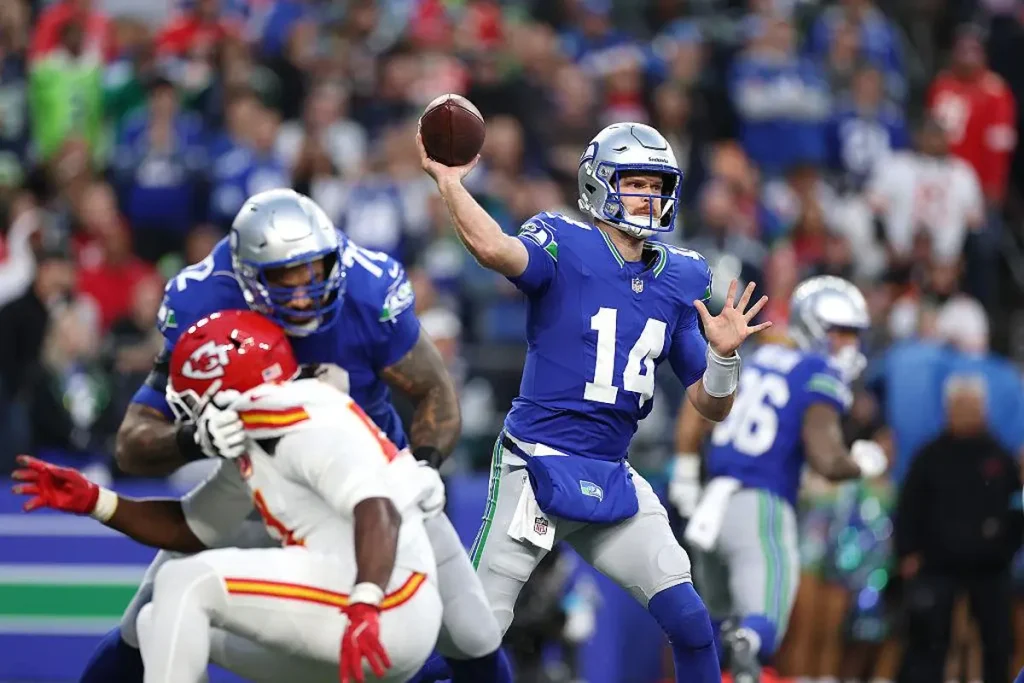
Sam Darnold completed 20 of 28 passes for 257 yards, one touchdown, and one interception. He finished with a 96.9 passer rating.
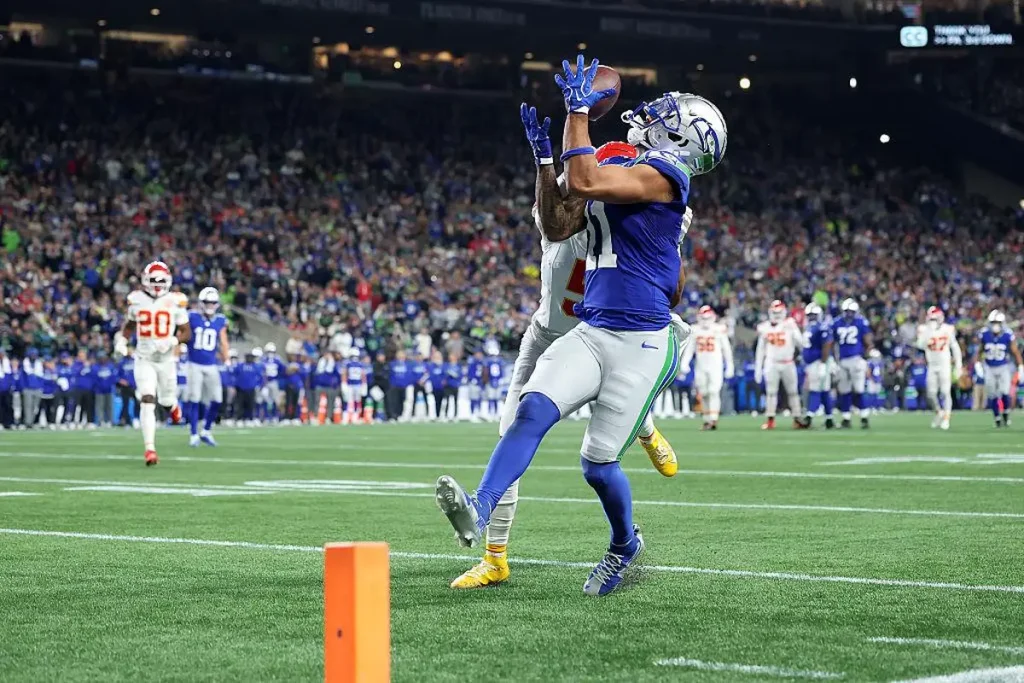
Darnold’s most important connection came in the second quarter. He found Smith-Njigba for a 28-yard touchdown, giving Seattle a 10–0 advantage. That play helped the Seahawks take control of the scoreboard and put pressure on Kansas City to respond.
Darnold did not need to take unnecessary risks throughout the game. Seattle’s rushing attack helped keep the offense balanced, and the defense gave the quarterback room to manage the game rather than chase points.
His interception was a blemish on an otherwise productive performance, but it did not prevent Seattle from controlling the contest.
Patrick Mahomes’ performance
Mahomes completed 19 of 33 passes for 165 yards. He did not throw a touchdown and was intercepted once.
Those numbers were well below the level Kansas City typically needs from its quarterback to win comfortably. Mahomes was unable to establish consistent explosive plays, and the Chiefs finished with only three points.
The Seattle defense limited the available passing opportunities and made it difficult for Kansas City to sustain drives. Mahomes also had to operate without much help from the running game, which reduced the balance of the Chiefs’ offense.
Mahomes added 14 rushing yards on two attempts, but his overall contribution was not enough to change the result.
Rushing Stats: Emanuel Wilson Leads Seattle
Seattle’s rushing production helped the team control the pace of the game. Emanuel Wilson carried the ball 24 times for 100 yards and scored a touchdown. His steady work gave the Seahawks a reliable option beyond the passing game.
Rushing leaders
| Player | Team | Carries | Rushing yards | Average | TD |
|---|---|---|---|---|---|
| Emanuel Wilson | Seahawks | 24 | 100 | 4.2 | 1 |
| Kenneth Walker III | Chiefs | 14 | 36 | 2.6 | 0 |
| Sam Darnold | Seahawks | 2 | 17 | 8.5 | 0 |
| Patrick Mahomes | Chiefs | 2 | 14 | 7.0 | 0 |
| George Holani | Seahawks | 5 | 11 | 2.2 | 0 |
| Velus Jones Jr. | Seahawks | 5 | 8 | 1.6 | 0 |
Note: Kenneth Walker III appeared in the Kansas City rushing statistics for this matchup.
Emanuel Wilson’s 100-yard game
Wilson was Seattle’s leading rusher and one of the most important players in the win. He finished with 100 yards on 24 attempts, averaging 4.2 yards per carry.
His biggest contribution came late in the fourth quarter. Wilson broke through for a 21-yard rushing touchdown with 3:47 remaining. The score made it 20–3 and effectively put the game out of reach.
Wilson’s workload also helped Seattle manage the clock. By continuing to gain yards on the ground, the Seahawks could keep the Chiefs’ offense off the field and protect their lead.

Kansas City’s rushing struggles
Kenneth Walker III recorded 36 yards on 14 carries, averaging 2.6 yards per attempt. He did not score a rushing touchdown.
Mahomes added 14 yards on two carries, but Kansas City lacked a consistent ground threat. The limited rushing output made it harder for the Chiefs to create manageable passing situations and sustain long drives.
Seattle’s ability to contain the run was an important part of its defensive success. The Chiefs could not use the ground game to take pressure off Mahomes.
Receiving Stats: Jaxon Smith-Njigba Takes Over
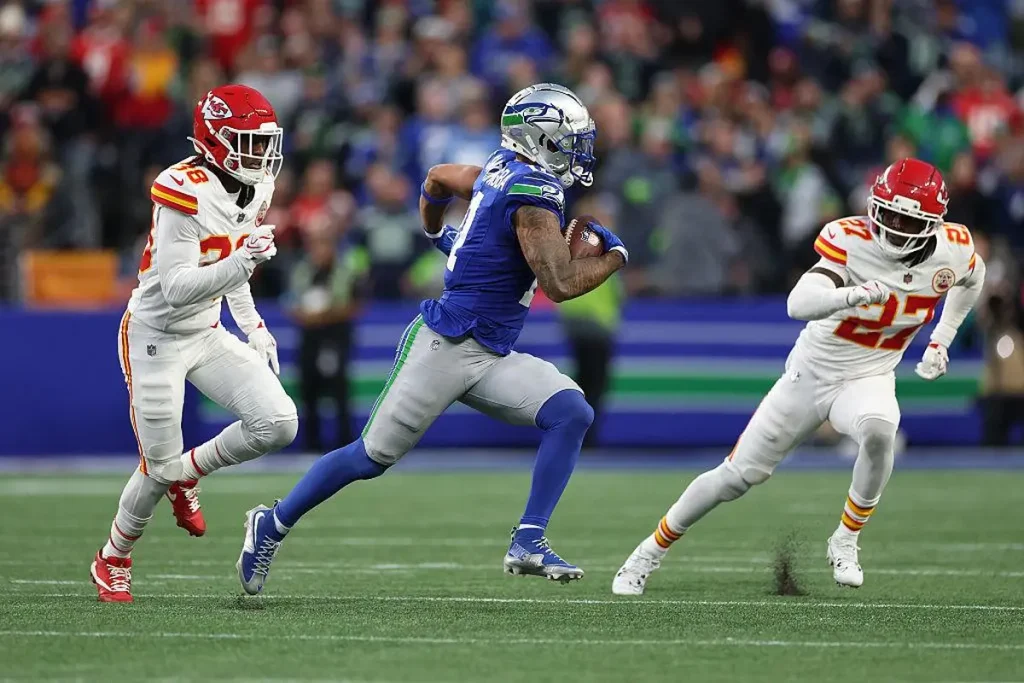
Jaxon Smith-Njigba was Seattle’s leading receiver and the game’s most productive pass catcher. He finished with nine receptions for 150 yards and one touchdown on 12 targets.
His performance gave Darnold a dependable downfield option and helped Seattle create separation on the scoreboard.
Receiving leaders
| Player | Team | Targets | Receptions | Receiving yards | TD |
|---|---|---|---|---|---|
| Jaxon Smith-Njigba | Seahawks | 12 | 9 | 150 | 1 |
| Travis Kelce | Chiefs | 8 | 4 | 44 | 0 |
| Noah Gray | Chiefs | 3 | 3 | 44 | 0 |
| AJ Barner | Seahawks | 5 | 4 | 42 | 0 |
| Cooper Kupp | Seahawks | 2 | 2 | 20 | 0 |
| Emanuel Wilson | Seahawks | 1 | 1 | 15 | 0 |
| George Holani | Seahawks | 2 | 1 | 12 | 0 |
| Rashid Shaheed | Seahawks | 3 | 2 | 1 | 0 |
Jaxon Smith-Njigba’s standout performance
Smith-Njigba caught nine of his 12 targets for 150 yards and a touchdown. His average of 16.7 yards per reception showed how effectively Seattle moved the ball through the air.
The highlight was his 28-yard touchdown reception in the second quarter. The connection with Darnold gave Seattle its first touchdown and created a two-score lead.
Smith-Njigba’s production also made life easier for the rest of the offense. Kansas City had to account for his ability to gain yards after the catch and create opportunities downfield.
He was the clear receiving leader in this matchup and a major reason Seattle’s passing attack was more productive.
Travis Kelce and the Chiefs’ receiving game
Travis Kelce led Kansas City’s pass catchers with four receptions for 44 yards on eight targets. Noah Gray also recorded four? No—Gray caught three passes for 44 yards on three targets, matching Kelce’s yardage total.
The Chiefs had some useful contributions from their tight ends, but those plays did not translate into touchdowns. Xavier Worthy caught three passes for 11 yards, while other receivers made smaller contributions.
Kansas City needed more explosive plays from its receiving group. Without a touchdown or a sustained scoring drive, the offense could not keep pace with Seattle.Pro Football Reference+2
Team Statistics: Seahawks Control the Game
The overall team numbers show why Seattle won. The Seahawks produced almost twice as many total yards as Kansas City and held the ball for more than 11 additional minutes.
Team comparison
| Statistic | Chiefs | Seahawks |
|---|---|---|
| Final score | 3 | 20 |
| Total net yards | 213 | 410 |
| Passing yards | 165 | 257 |
| Rushing yards | 50 | 153 |
| Time of possession | 24:09 | 35:51 |
| Penalties | 2 | 4 |
| Penalty yards | 15 | 20 |
Seattle finished with 410 total yards, compared with 213 for Kansas City. The Seahawks also had a significant advantage in time of possession, holding the ball for 35 minutes and 51 seconds.
That difference mattered because it limited the Chiefs’ opportunities to build offensive rhythm. Seattle’s offense sustained drives, while its defense forced Kansas City to work for every yard.
The penalty numbers were relatively close. Kansas City committed two penalties for 15 yards, while Seattle had four penalties for 20 yards. Penalties were not the defining factor in the result.
The biggest differences were offensive efficiency, rushing production, and Seattle’s ability to control possession.
Key Scoring Plays and Game Timeline
The game began quietly, with neither team scoring in the first quarter. Seattle gradually built its advantage and never allowed Kansas City to recover.
Second quarter: Seattle takes the lead
Jason Myers opened the scoring with a 25-yard field goal at 8:22 in the second quarter. That gave Seattle a 3–0 lead.
The Seahawks added the first touchdown of the game at 1:44. Darnold connected with Smith-Njigba for a 28-yard score, and Myers converted the extra point.
Seattle went into halftime ahead 10–0. The Chiefs had not found a scoring answer.
Third quarter: Both teams add a field goal
Myers extended Seattle’s lead with a 35-yard field goal at 8:09 in the third quarter. The Seahawks moved ahead 13–0.
Kansas City finally got on the scoreboard when Harrison Butker made a 50-yard field goal at 1:42. It was the Chiefs’ only scoring play of the night.
The third quarter ended with Seattle ahead 13–3.
Fourth quarter: Wilson seals the win
Seattle added the final points at 3:47 in the fourth quarter. Wilson scored on a 21-yard rushing attempt, and Myers made the extra point.
The touchdown pushed the lead to 20–3. Kansas City could not produce a late comeback, and Seattle secured the victory.Pro Football Reference+1
Why the Seahawks Beat the Chiefs
Seattle’s victory came from a combination of offensive balance, strong possession control, and defensive pressure. The Seahawks did not rely on one player or one type of play. They used the passing game to create scoring opportunities and the running game to maintain control.
1. Seattle won the yardage battle
The Seahawks gained 410 total yards, nearly 200 more than the Chiefs. That advantage gave Seattle more opportunities to move the chains and create scoring chances.
Kansas City’s 213 yards were not enough to sustain a competitive offensive performance.
2. Smith-Njigba created explosive plays
Smith-Njigba’s 150 receiving yards gave Seattle a major advantage through the air. His touchdown catch was a turning point because it helped the Seahawks establish a 10-point lead before halftime.
His ability to turn targets into significant yardage made Seattle’s passing game difficult to contain.
3. Wilson kept the offense balanced
Wilson’s 100 rushing yards gave Seattle a strong ground presence. His fourth-quarter touchdown also helped finish the game.
A productive running game can make a passing attack more effective by preventing the defense from focusing entirely on the quarterback. Seattle benefited from that balance.
4. Kansas City could not find the end zone
The Chiefs finished with only three points. Mahomes threw for 165 yards, but Kansas City did not record a passing touchdown or rushing touchdown.
Without touchdowns, the Chiefs had little chance of overcoming Seattle’s lead.
5. Seattle controlled possession
The Seahawks held the ball for 35:51, compared with 24:09 for Kansas City. That helped Seattle control the tempo and reduce the number of possessions available to the Chiefs.
The longer Seattle maintained its drives, the less time Kansas City had to build momentum.
Chiefs Player Stats: Who Made an Impact?
Although Kansas City lost, several players contributed to the team’s offensive production.
Patrick Mahomes: Mahomes completed 19 of 33 passes for 165 yards and threw one interception. He also rushed twice for 14 yards.
Travis Kelce: Kelce caught four passes for 44 yards on eight targets. He was one of the Chiefs’ leading receiving options.
Noah Gray: Gray recorded three receptions for 44 yards. His 14.7 yards per catch provided a useful contribution in a difficult offensive performance.
Kenneth Walker III: Walker carried the ball 14 times for 36 yards and caught four passes for 21 yards. He did not score a touchdown.
Xavier Worthy: Worthy caught three passes for 11 yards on six targets. Kansas City needed more production from its wide receivers to challenge Seattle.
The main issue for the Chiefs was not a complete absence of individual contributions. It was the team’s inability to combine those contributions into scoring drives.
Seahawks Player Stats: Who Led the Win?
Seattle received strong performances from its quarterback, top receiver, and leading running back.
Sam Darnold: Darnold completed 20 of 28 passes for 257 yards, one touchdown, and one interception. His 96.9 passer rating reflected a productive night.
Jaxon Smith-Njigba: Smith-Njigba led all receivers with nine catches for 150 yards and a touchdown.
Emanuel Wilson: Wilson rushed 24 times for 100 yards and a touchdown. He was Seattle’s leading rusher.
AJ Barner: Barner caught four passes for 42 yards on five targets, giving Darnold another reliable option.
Cooper Kupp: Kupp finished with two receptions for 20 yards. Although his numbers were modest, he contributed to the Seahawks’ receiving depth.
The combination of Darnold’s passing, Wilson’s rushing, and Smith-Njigba’s receiving production gave Seattle a balanced offensive performance.
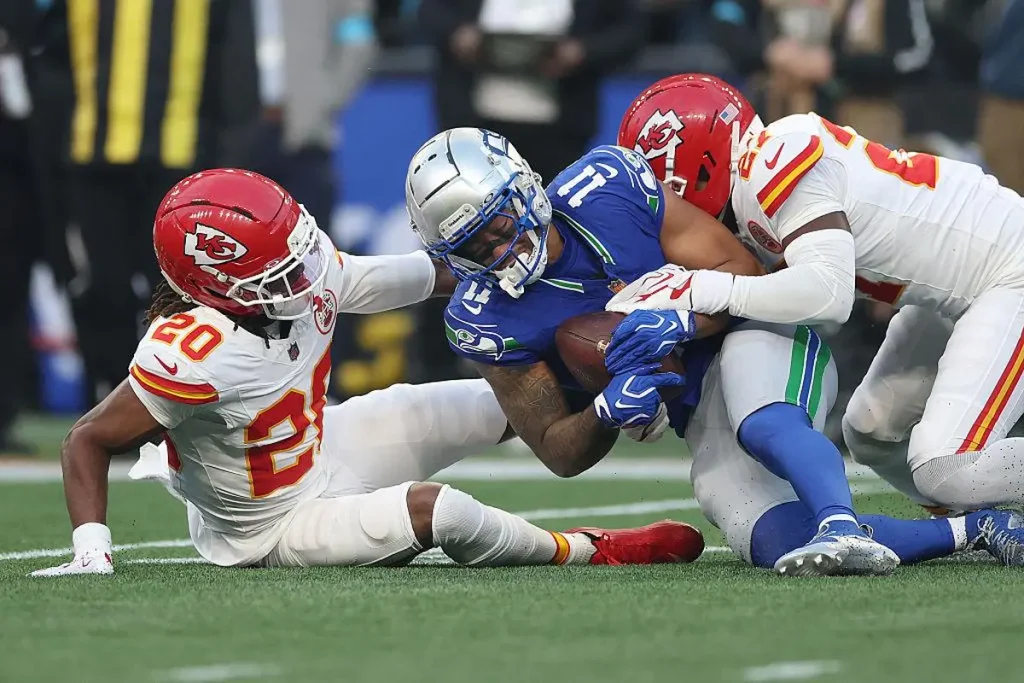
What the Result Means for Both Teams
The win improved Seattle’s record to 4–3 and gave the Seahawks a valuable victory against an unbeaten opponent. It also demonstrated how effective the team could be when its passing and rushing attacks worked together.
For Kansas City, the loss moved the Chiefs to 5–1. The result ended their unbeaten start and highlighted areas that needed improvement.
The Chiefs had to look at their offensive consistency, rushing production, and ability to convert drives into touchdowns. A team can move the ball in short stretches, but it must finish possessions with points against strong opponents.
Seattle, meanwhile, could take confidence from its defensive performance. Holding Mahomes and the Chiefs to three points was a significant achievement, especially while producing more than 400 yards on offense.
Chiefs vs Seahawks Match Player Stats: Biggest Takeaways
The chiefs vs seahawks match player stats tell a clear story: Seattle won because it produced more on offense and prevented Kansas City from scoring touchdowns.
Here are the most important numbers from the matchup:
- Final score: Seattle Seahawks 20, Kansas City Chiefs 3.
- Top passer: Sam Darnold with 257 passing yards and one touchdown.
- Chiefs passing leader: Patrick Mahomes with 165 passing yards.
- Top rusher: Emanuel Wilson with 100 yards and one touchdown.
- Top receiver: Jaxon Smith-Njigba with 150 yards and one touchdown.
- Chiefs receiving leaders: Travis Kelce and Noah Gray each recorded 44 receiving yards.
- Total yardage: Seattle gained 410 yards, while Kansas City recorded 213.
- Time of possession: Seattle held the ball for 35:51.
The most important individual performance belonged to Smith-Njigba, whose 150 receiving yards and touchdown helped Seattle create separation. Wilson’s 100-yard rushing effort provided balance, while Darnold delivered an efficient passing performance.
For Kansas City, the biggest concern was its inability to score a touchdown. Mahomes and the offense struggled to create consistent production, and the defense spent too much time on the field.
Frequently Asked Questions
1. What was the final score of Chiefs vs Seahawks on October 25, 2026?
The Seattle Seahawks defeated the Kansas City Chiefs 20–3 at Lumen Field in Week 7 of the 2026 NFL regular season.
2. How many passing yards did Patrick Mahomes record?
Patrick Mahomes completed 19 of 33 passes for 165 yards. He threw no touchdowns and one interception.
3. How many passing yards did Sam Darnold have?
Sam Darnold completed 20 of 28 passes for 257 yards, one touchdown, and one interception.
4. Who had the most receiving yards in the game?
Jaxon Smith-Njigba led all players with 150 receiving yards. He caught nine passes on 12 targets and scored one touchdown.
5. Who led the game in rushing yards?
Emanuel Wilson led the rushing category with 100 yards on 24 carries. He also scored a rushing touchdown in the fourth quarter.
6. How many receiving yards did Travis Kelce have?
Travis Kelce recorded four receptions for 44 yards on eight targets. He did not score a touchdown.
7. How many total yards did the Seahawks record?
Seattle finished with 410 total net yards, including 257 passing yards and 153 rushing yards.
8. Why did the Chiefs lose to the Seahawks?
Kansas City struggled to move the ball consistently and scored only three points. Seattle gained 410 yards, controlled possession, and recorded both a passing touchdown and a rushing touchdown.
9. Where was the Chiefs vs Seahawks game played?
The game took place at Lumen Field in Seattle, Washington, on October 25, 2026.
10. Who scored the Seahawks’ touchdowns?
Jaxon Smith-Njigba scored on a 28-yard reception from Sam Darnold in the second quarter. Emanuel Wilson added a 21-yard rushing touchdown in the fourth quarter.
Final Thoughts
The October 25 matchup showed how effectively Seattle could control a game through balanced offense and strong defensive execution. The Seahawks defeated the Chiefs 20–3, ended Kansas City’s unbeaten start, and produced a convincing performance in front of their home crowd.
Smith-Njigba’s 150 receiving yards, Wilson’s 100 rushing yards, and Darnold’s 257 passing yards were the leading individual contributions. Kansas City, by contrast, struggled to establish its offense and could not score a touchdown.
For readers reviewing the chiefs vs seahawks match player stats, the key takeaway is the difference in overall production. Seattle gained nearly twice as many yards, controlled possession, and made its scoring opportunities count. Those advantages turned a close opening quarter into a comfortable Seahawks victory.
2 thoughts on “Chiefs vs Seahawks Match Player Stats: (2026 Guide)”