The phrase highkey meaning is commonly searched by people who see highkey in TikTok comments, Instagram captions, text messages, or everyday conversations. In modern American slang, highkey means openly, strongly, or very clearly. For example, if someone says, “I highkey love this song,” they’re admitting that they genuinely love it and aren’t trying to hide their feelings.
The word is often used to express excitement, attraction, honesty, or a strong opinion. You might hear a friend say, “I’m highkey excited for the concert,” or see someone post, “Highkey need a vacation.” In both cases, the speaker emphasizes how strongly they feel.
The expression is also closely connected to lowkey, which often means somewhat, secretly, or without drawing too much attention. These two slang terms can express different levels of openness or intensity, depending on the sentence.
This guide explains the definition, pronunciation, origin, grammar, examples, and everyday uses of highkey. You’ll also learn how it differs from similar slang expressions and how to use it naturally in American English.
Quick Answer
Highkey is informal slang meaning openly, definitely, or very strongly. For example, “I highkey want pizza” means you genuinely want pizza and are expressing that desire clearly. People commonly use it in texts, social media posts, and casual conversations to emphasize feelings, opinions, or preferences.
Highkey vs. Lowkey
Highkey and lowkey are closely related slang terms, but they usually express different levels of intensity or openness. Understanding the contrast makes both words easier to use.
| Feature | Highkey | Lowkey |
|---|---|---|
| Main meaning | Strongly, openly, or definitely | Somewhat, quietly, or discreetly |
| Tone | Direct and emphatic | Subtle or understated |
| Example | “I highkey love this movie.” | “I lowkey like this movie.” |
| Feeling | Strong enthusiasm or certainty | Mild interest or a restrained confession |
| Common use | Emphasizing a clear feeling | Softening a statement |
For a closer look at the other half of this slang pair, read .
Examples of Highkey and Lowkey in the Same Conversation
Example 1: Food
- Highkey: “I highkey want a burger right now.”
- Lowkey: “I lowkey want a burger, but I’m not that hungry.”
The first sentence expresses a strong desire. The second presents the desire more casually or mildly.
Example 2: Attraction
- Highkey: “I highkey have a crush on him.”
- Lowkey: “I lowkey have a crush on him.”
The first sounds like an open admission. The second can suggest that the speaker is sharing the feeling discreetly or admitting it with some hesitation.
Example 3: Music
- Highkey: “This is highkey my favorite song.”
- Lowkey: “This is lowkey one of my favorite songs.”
The first emphasizes the speaker’s strong preference. The second makes the statement sound more restrained.
Keep in mind that lowkey can mean either “somewhat” or “secretly,” depending on context. Similarly, highkey can emphasize intensity, openness, or certainty. The contrast isn’t always an exact one-to-one comparison.
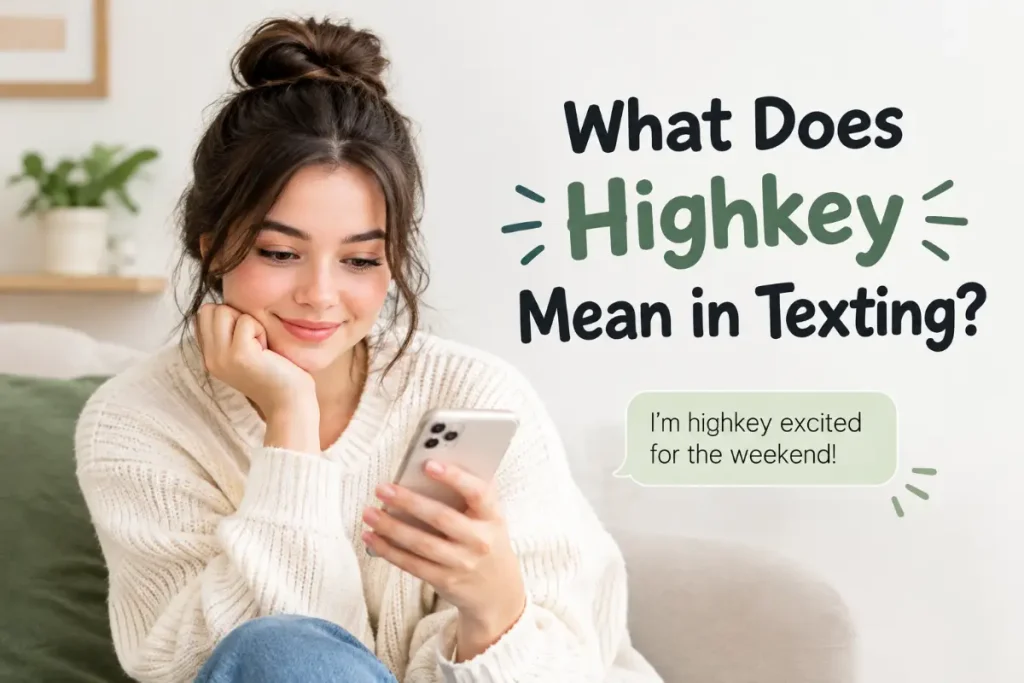
What Does Highkey Mean in Texting?
In text messages, highkey is an informal way to make your feelings or opinions more noticeable. It helps communicate enthusiasm, honesty, or intensity without requiring a long explanation.
Here are some realistic texting examples.
Are you excited about the trip?
Friend
I’m highkey counting down the days.
You
Did you like the new episode?
Friend
Highkey, I need the next episode now.
You
In both conversations, the word adds emphasis and makes the response sound casual. It’s particularly useful in chats with friends who understand internet slang.
Common Texting Expressions
- “Highkey obsessed with this song.”
- “I highkey need a vacation.”
- “Highkey, that was the best movie I’ve seen all year.”
- “I’m highkey nervous about tomorrow.”
- “I highkey agree with you.”
- “This might be highkey the funniest thing I’ve seen.”
The expression can communicate positive or negative feelings. For example, “I’m highkey stressed” emphasizes stress, while “I’m highkey excited” emphasizes excitement.
Is Highkey Meaning Formal or Informal?
In its modern slang sense, highkey is informal. It’s appropriate for casual conversations, texts, social media captions, and friendly interactions. However, it usually isn’t the best choice for academic papers, formal emails, business reports, or professional documents.
Consider these examples:
| Informal sentence | More formal alternative |
|---|---|
| “I’m highkey excited about the results.” | “I’m very excited about the results.” |
| “I highkey disagree with this idea.” | “I strongly disagree with this idea.” |
| “That test was highkey difficult.” | “That test was extremely difficult.” |
| “I’m highkey interested in this role.” | “I’m very interested in this position.” |
| “We highkey need more time.” | “We urgently need more time.” |
The formal alternatives communicate the same basic ideas without relying on slang. They also make the intended meaning clear to readers who may be unfamiliar with internet expressions.
Can You Use Highkey at Work?
You can use it in a relaxed conversation with coworkers if the tone suits the setting. For example, “I’m highkey excited about the team outing” may sound natural among colleagues who regularly use slang.
However, a professional email would usually sound better with “I’m really looking forward to the team outing.”
The best choice depends on your audience, purpose, and relationship with the reader. When clarity and professionalism matter most, standard English is usually the safer option.
Grammar and Correct Usage
Although highkey is slang, it follows recognizable patterns in everyday English. Speakers often use it as an adverb to modify a verb, an adjective, or an entire statement.
1. Highkey Before a Verb
The word can appear before a verb to emphasize an action, feeling, or preference.
Examples:
- “I highkey love this restaurant.”
- “She highkey wants to move to California.”
- “We highkey need a day off.”
- “They highkey regret missing the concert.”
In each example, highkey strengthens the statement. It tells the reader that the feeling or desire is significant.
2. Highkey Before an Adjective
It can also emphasize an adjective that describes a feeling, condition, or opinion.
Examples:
- “I’m highkey excited.”
- “That exam was highkey difficult.”
- “He’s highkey talented.”
- “This movie is highkey hilarious.”
Here, the word works much like really, very, or extremely.
3. Highkey at the Beginning of a Sentence
Sometimes, people place the expression at the beginning of a sentence to emphasize the entire statement.
Examples:
- “Highkey, I think we should leave early.”
- “Highkey, this is my favorite restaurant.”
- “Highkey, I wasn’t expecting that ending.”
The comma is useful when the word introduces a complete thought. In short, casual messages, people often leave out punctuation, but standard punctuation helps make longer sentences easier to read.
4. Highkey at the End of a Sentence
The word can also appear at the end for emphasis, although this placement may sound less natural in some sentences.
For example:
- “I want to go to that concert, highkey.”
- “That was the best dessert, highkey.”
This style is conversational and often appears in playful online writing. In most situations, placing the word before the verb or adjective sounds more natural.
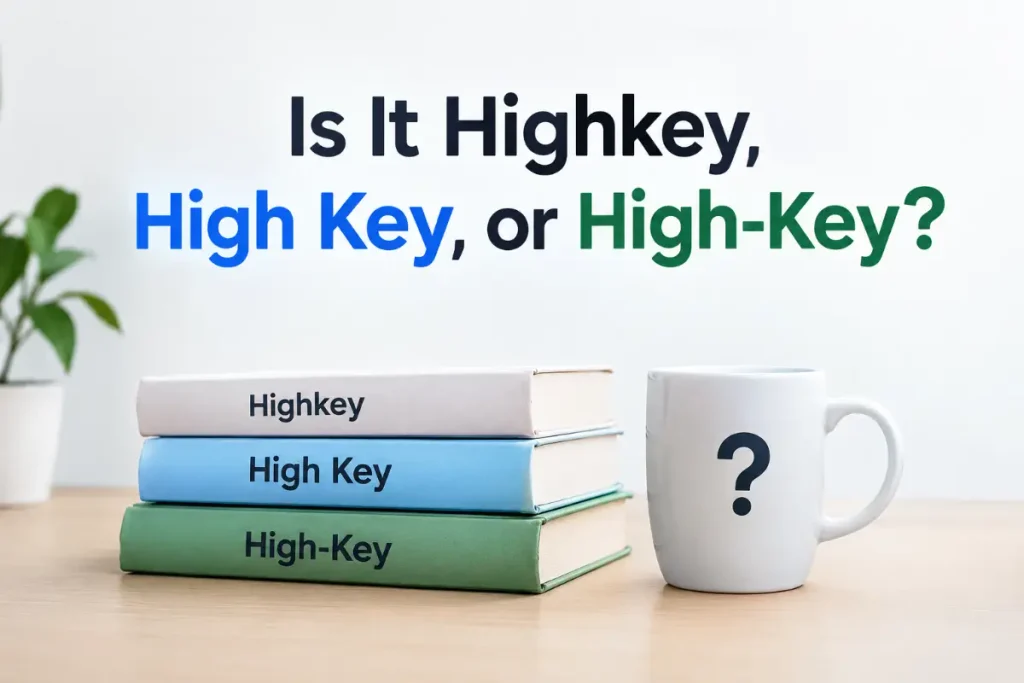
Is It Highkey, High Key, or High-Key?
All three forms can appear in English, but the best spelling depends on the intended use.
- Highkey: A common spelling in modern internet slang.
- High key: A two-word form sometimes used in informal writing.
- High-key: A hyphenated form associated with standard compound usage and dictionary entries.
Merriam-Webster’s slang entry uses high-key and recognizes high key and highkey as variants. It defines the slang as an expression meaning “straight up,” “seriously,” or “extremely.” You can explore the Merriam-Webster slang entry for high-key.
For a social media caption or text message, highkey is a familiar choice. For formal writing, consider replacing the slang with really, strongly, definitely, or extremely, depending on the sentence.
Consistency matters, too. If you’re writing an article about internet slang, choose one spelling for the main discussion and explain the alternatives where useful.
Common Mistakes to Avoid
Even familiar slang can be confusing when used in the wrong context. These are some mistakes worth avoiding.
Mistake 1: Thinking Highkey Always Means Secretly
This is a common misunderstanding because people often confuse it with lowkey.
Incorrect interpretation: “I highkey like her” means “I secretly like her.”
More natural interpretation: “I highkey like her” means “I really like her” or “I’m openly admitting that I like her.”
The word generally emphasizes intensity or openness, rather than secrecy.
Mistake 2: Assuming It Always Means Something Positive
The expression can emphasize negative feelings, too.
Examples:
- “I’m highkey worried about the exam.”
- “That movie was highkey disappointing.”
- “I highkey regret staying up so late.”
The word strengthens the statement without changing a negative feeling into a positive one.
Mistake 3: Using It in Every Sentence
Repeating the same slang expression can make your writing sound unnatural. Instead, use alternatives such as really, definitely, honestly, seriously, and extremely when they fit.
For example, rather than writing “I’m highkey tired, highkey hungry, and highkey ready to sleep,” you could write, “I’m exhausted, starving, and ready to sleep.”
Mistake 4: Treating Slang Like Formal Vocabulary
Slang can make a message sound friendly and expressive, but it may weaken a formal document.
Instead of “I highkey recommend this approach,” write “I strongly recommend this approach” in a professional report.
Mistake 5: Ignoring Context and Tone
A sentence can carry different emotional shades depending on the conversation. “I’m highkey jealous” might be a playful admission between friends or a serious expression of envy.
Pay attention to the situation and the speaker’s tone rather than relying on the slang word alone.
Frequently Asked Questions
1. What does Highkey Meaning in simple words?
In simple words, highkey means really, openly, or definitely. It’s used to emphasize a feeling, opinion, or desire. For example, “I highkey love this song” means you genuinely love the song and want to make that feeling clear. It’s common in casual American English.
2. What does highkey mean on TikTok?
On TikTok, highkey usually emphasizes a strong feeling or opinion. Someone might comment “Highkey obsessed” under a video they love or write “I’m highkey jealous” about an exciting vacation. The expression makes the reaction more emphatic and helps creators communicate their feelings in a short, casual way.
3. What does highkey mean in texting?
In text messages, highkey means something like “really,” “strongly,” or “openly.” For example, “I highkey want to go” means you genuinely want to go and are emphasizing that desire. It’s an informal expression commonly used in conversations between friends.
4. Is highkey the opposite of lowkey?
Generally, yes. Highkey emphasizes strong feelings or open expression, while lowkey often softens a statement or suggests a feeling is being shared discreetly. For example, “I highkey love this show” expresses strong enthusiasm, while “I lowkey like this show” sounds more restrained.
5. Is highkey a real word?
Yes, high-key is an established English expression with both traditional and slang uses. In modern slang, it functions as an informal intensifier. Although it may not suit formal writing, it has a recognizable meaning in everyday conversation and online communication.
6. Can highkey describe negative feelings?
Yes. The expression emphasizes the strength of a feeling, so it can describe negative emotions as easily as positive ones. For example, “I’m highkey stressed about the deadline” means the speaker feels very stressed. Likewise, “I highkey regret that decision” expresses strong regret.
7. How do you use highkey in a sentence?
You can place it before a verb, an adjective, or at the beginning of a statement. Examples include “I highkey love this song,” “That test was highkey difficult,” and “Highkey, I need a vacation.” In each case, the word adds emphasis and keeps the tone informal.
8. Is highkey appropriate for school or work?
It depends on the situation. In casual conversations with classmates or coworkers, the expression may sound natural. In academic essays, formal presentations, and professional emails, alternatives such as strongly, really, definitely, and extremely are usually more appropriate.
9. What are some synonyms for highkey?
Useful alternatives include really, very, extremely, definitely, strongly, and honestly. The best choice depends on the sentence. For example, “I highkey agree” can become “I strongly agree,” while “I’m highkey excited” can become “I’m extremely excited.”
10. How do you spell highkey correctly?
In informal online writing, highkey is a common spelling. You may also encounter high key and high-key. The hyphenated form appears in dictionary entries, while the one-word spelling is popular in slang. For formal writing, choose a standard alternative if the slang expression doesn’t suit the context.
Conclusion
Understanding highkey meaning helps you recognize how people emphasize their feelings and opinions in modern American slang. The expression usually means really, strongly, openly, or definitely, depending on the context. You’ll often see it in text messages, social media captions, comments, and casual conversations.
Remember the main difference: highkey makes a statement more emphatic, while lowkey often makes it sound more restrained or discreet. Use both expressions naturally with friends and online audiences, but choose clearer alternatives in formal writing.
The next time someone says, “I highkey love this,” you’ll know they’re expressing a strong feeling rather than keeping it quiet.
1 thought on “Highkey Meaning: 7 Easy Ways to Use This Popular Slang Word”