Important date note: Texas A&M and Alabama played on October 24, 2026. This article covers the injury and availability information reported before that game, including the final game-day updates. It is a retrospective report, not a live injury list for a future matchup.
Texas A&M vs Alabama Injury Report: Quick Overview
The October 24 SEC matchup between Texas A&M and Alabama came with significant availability concerns on both sides. Alabama entered the game without several players, including wide receiver Ryan Coleman-Williams and linebacker Desmond Umeozulu. The Crimson Tide also ruled out cornerback Zabien Brown, running back EJ Crowell, and center Racin Delgatty in its final game-day update.
Texas A&M had its own list of absences. Wide receivers Terry Bussey and Kelshaun Johnson and offensive lineman Blake Ivy were listed out. Defensive end Anto Saka was a game-time decision, while several players who had appeared on the earlier questionable list were upgraded to available.
The final reports matter more than the first injury update of the week. A player listed as questionable on Wednesday may be cleared by Saturday, while another player can be downgraded closer to kickoff. The sections below separate the early-week designations from the final reported statuses so readers can understand what each team actually faced.
Alabama Injury Report Before the Texas A&M Game
Alabama’s injury situation changed during the week leading up to the October 24 matchup. The initial SEC availability report listed multiple players as out, while four additional players were marked questionable. The final report then ruled several of those questionable players out.
Alabama players ruled out
| Player | Position | Final status | Reported information |
|---|---|---|---|
| Ryan Coleman-Williams | Wide receiver | Out | Meniscus injury; had undergone arthroscopic surgery |
| Desmond Umeozulu | Linebacker | Out | Turf toe |
| Zabien Brown | Defensive back | Out | Lower-leg injury |
| EJ Crowell | Running back | Out | Lower-leg injury |
| Racin Delgatty | Offensive line | Out | Knee injury |
| Terrance Green | Defensive line | Out | Ankle injury |
| Cayden Jones | Linebacker | Out | Listed out for the season |
| Nick Sherman | Defensive back | Out | Listed unavailable |
| Jeremiah Beaman | Defensive line | Out | Listed out for the season |
| Dre Kirkpatrick Jr. | Defensive back | Out | Ruled out for a team-rules violation, not an injury |
The final game-day report listed 10 Alabama players as unavailable. It is important to distinguish injury absences from other reasons for being unavailable: Dre Kirkpatrick Jr., for example, was reported out because of a team-rules violation, not because of a physical injury. On3+1
Ryan Coleman-Williams: A major receiving absence
Ryan Coleman-Williams was one of the most notable names on Alabama’s report. The wide receiver was ruled out after dealing with a meniscus injury that required arthroscopic surgery. He had missed the previous game against Tennessee, so his absence against Texas A&M was not a last-minute surprise.
His unavailability mattered because Alabama lost an established option in its passing game. Coleman-Williams had been among the team’s leading receivers, with 415 receiving yards reported before the matchup. When a productive receiver is unavailable, the remaining wideouts must take on more routes, targets, and responsibility in important passing situations.
That does not automatically mean the offense will struggle. A team can replace a missing receiver through a combination of players, different formations, and a greater role for its tight ends or running backs. However, losing a leading target can affect timing and reduce the number of experienced options available to the quarterback.
Desmond Umeozulu: A linebacker unavailable
Linebacker Desmond Umeozulu was also listed out. His reported issue was turf toe, and he had not played since Alabama’s September 19 game against Florida State.
A linebacker absence can affect several parts of a defense. Linebackers help stop the run, cover tight ends and running backs, communicate adjustments, and respond to formations that create mismatches. If a team is missing a linebacker who normally contributes to those responsibilities, other defenders may need to handle more snaps or take on different assignments.
Against an opponent with multiple ways to attack, depth at linebacker can become especially important. Texas A&M could test the middle of the field, use play-action, or try to create space for its running game. Alabama needed its available defenders to communicate well and avoid giving the Aggies easy yards after contact.
Zabien Brown: Secondary depth takes a hit
Cornerback Zabien Brown was initially questionable after suffering a lower-leg injury against Tennessee. The final report ruled him out.
Brown’s absence was important because cornerbacks are asked to handle difficult assignments against wide receivers in space. A defense without one of its expected contributors may need to adjust its coverage combinations, rely on other defensive backs, or provide additional safety help.
Alabama’s reported plan involved using Dijon Lee and Carmelo O’Neal in the cornerback rotation. That meant the replacements had to be ready for the speed and route combinations Texas A&M could present.
The effect of a cornerback absence is not limited to one player matchup. It can influence how aggressively a defense blitzes, how much safety help it provides, and whether it can maintain tight coverage without exposing the middle of the field.
EJ Crowell: Another running back unavailable
Running back EJ Crowell was also ruled out after suffering a lower-leg injury against Tennessee. The absence reduced Alabama’s available options in the backfield.
A running back rotation can help an offense keep players fresh, vary running styles, and maintain a reliable option when the starter needs a break. When one member of that rotation is unavailable, the remaining backs may receive additional carries or responsibilities in pass protection.
Alabama was expected to turn to other available options, including AK Dear and Kevin Riley, for opportunities in the backfield. The exact distribution of carries depends on game flow, performance, and coaching decisions, so an injury report alone cannot tell readers which player will receive the largest workload. On3+1
Racin Delgatty: An offensive-line concern
Center Racin Delgatty was ruled out with a knee injury. His absence was particularly relevant because the center position is responsible for more than blocking the defensive tackle directly in front of him.
The center helps coordinate the offensive line, communicate protection adjustments, and ensure that the snap reaches the quarterback cleanly. A replacement center must build timing with the quarterback and the rest of the line, especially when facing defensive fronts that use movement and late shifts.
Alabama turned to Mal Waldrep at center for the matchup. That adjustment required the offensive line to maintain communication and keep its assignments organized against Texas A&M’s defensive pressure.
Texas A&M Injury Report Before Facing Alabama
Texas A&M also entered the game with several players unavailable. Its early-week report included three players listed out and five marked questionable. However, the Aggies received some positive news before kickoff when multiple questionable players were upgraded to available.
Texas A&M players listed out
| Player | Position | Reported status |
|---|---|---|
| Terry Bussey | Wide receiver | Out |
| Kelshaun Johnson | Wide receiver | Out |
| Blake Ivy | Offensive line | Out |
These absences affected both the receiving group and offensive-line depth. Bussey and Johnson were unavailable as receiving options, while Ivy’s absence reduced the number of offensive linemen available for rotation.
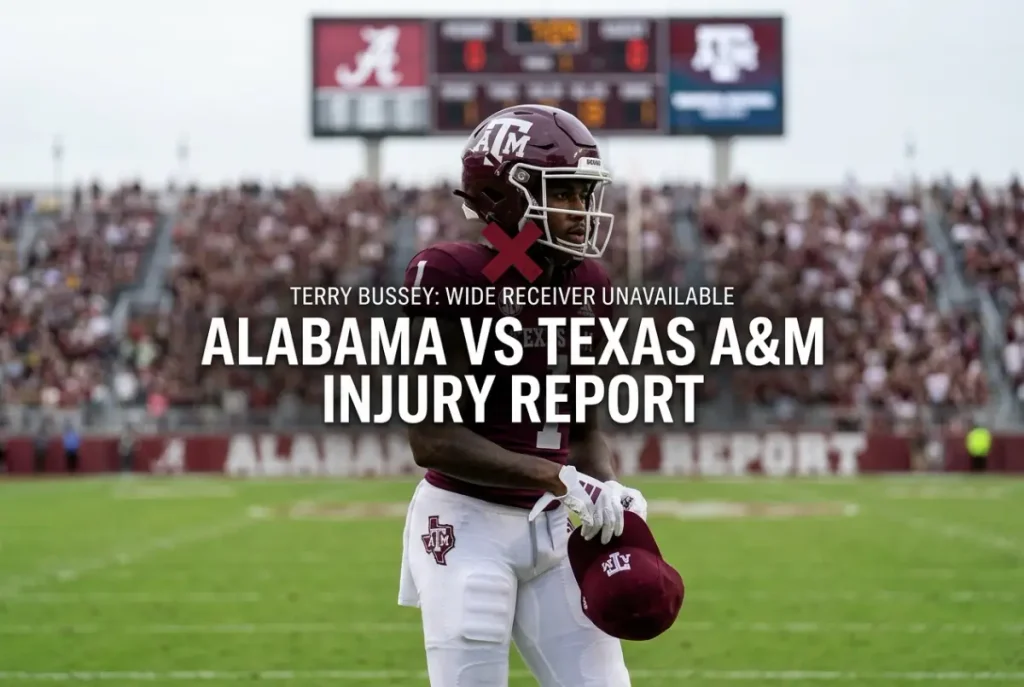
Terry Bussey: Wide receiver unavailable
Terry Bussey was listed out ahead of the Alabama game. His absence meant Texas A&M had one fewer wide receiver available for its passing attack.
Wide receiver depth matters because offenses need players who can win on the outside, work from the slot, stretch coverage, and make catches in traffic. Losing a receiver can force other players to handle more snaps and can change how an offense uses its personnel.
Texas A&M needed its available receivers to execute their routes and take advantage of the opportunities created by the offensive scheme. Against Alabama, winning individual matchups and sustaining drives were important because every missed opportunity could make it harder to keep pace.
Kelshaun Johnson: Another receiving option out
Kelshaun Johnson was also ruled out. His absence added to the challenge for the Aggies’ receiving rotation.
With two wide receivers unavailable, Texas A&M had to rely more heavily on the players who were cleared to participate. That could mean additional snaps for the remaining wideouts and more opportunities for other pass-catching options.
An injury report does not reveal the full depth chart or guarantee how targets will be distributed. It does, however, help explain why a team’s available personnel may look different from its usual lineup.
Blake Ivy: Offensive-line depth affected
Offensive lineman Blake Ivy was the third Texas A&M player listed out in the final pregame picture. Offensive-line injuries can have a wider impact than the absence of a single skill-position player because the line works as a coordinated unit.
When a lineman is unavailable, the coaching staff may need to adjust the starting combination, use a reserve, or move players between positions. Those changes can influence run blocking, pass protection, and communication.
Texas A&M needed its offensive line to keep the pocket stable and create enough room for the run game. Against a defense with Alabama’s talent and depth, even a small breakdown in protection could disrupt a drive.
Anto Saka: Game-time decision
Defensive end Anto Saka was the key Texas A&M name to watch late in the week. He had been listed as questionable and was described as a game-time decision in the final pregame reporting.
A defensive end’s availability can affect the pass rush and the defense’s ability to set the edge against the run. If a player at that position cannot go, other defensive linemen may have to absorb more snaps.
Saka’s final designation should not be confused with the players officially listed out. A game-time decision means the team was still evaluating his availability close to kickoff. The pregame report identified him as a decision to monitor rather than confirming that he would definitely play. Third and Data+1
Texas A&M Players Upgraded Before Kickoff
One of the most important developments in the final Texas A&M vs Alabama injury report was that several Aggies who had appeared on the questionable list were upgraded to available.
| Player | Position | Early-week status | Final reported update |
|---|---|---|---|
| Mario Craver | Wide receiver | Questionable | Available |
| DJ Hicks | Defensive tackle | Questionable | Available |
| Daymion Sanford | Linebacker | Questionable | Available |
| Trovon Baugh | Offensive line | Questionable | Available |
| Anto Saka | Defensive end | Questionable | Game-time decision |
This distinction is important for anyone reviewing the matchup after the fact. An early-week injury designation is not the same as a final game-day status. The Aggies had several players return to the available category, giving them more options than the initial report suggested. Third and Data+1
Mario Craver: Positive news for the passing game
Wide receiver Mario Craver was one of the most important players on Texas A&M’s early-week questionable list. He had been dealing with an injury and had missed the team’s previous game against The Citadel.
Craver was reported available in the final update. That was encouraging for the Aggies because he was an established part of their receiving group. Before the Alabama matchup, he had recorded 24 catches for 241 yards and two touchdowns, according to the pregame reporting.
Having Craver available gave Texas A&M another experienced option in the passing game. His presence could help the Aggies spread the field, create different route combinations, and avoid placing too much responsibility on a small number of receivers.
Availability does not guarantee a full workload, however. A player returning from an injury may have a different snap count or role depending on how the coaching staff evaluates his condition. The final designation confirmed that Craver was available, but it did not establish how many plays he would participate in.
DJ Hicks: Defensive-line depth restored
Defensive tackle DJ Hicks was also upgraded to available. His status was worth watching because defensive tackles help control the interior of the line, occupy blockers, and make it more difficult for an offense to run between the tackles.
Hicks had recorded six tackles and five pressures in the season statistics cited in the pregame report. Having him available gave Texas A&M another option in the defensive-line rotation.
Against Alabama, interior pressure could be valuable. It can force a quarterback to move off his preferred spot, disrupt the timing of passing plays, and create opportunities for other defenders to reach the backfield.
His availability also helped the Aggies maintain more depth up front. Defensive-line rotations are important over a full game because players must handle repeated physical snaps while remaining effective against both the run and pass.
Daymion Sanford: More linebacker options
Linebacker Daymion Sanford was another Aggie upgraded to available. His earlier questionable designation had raised concerns about Texas A&M’s depth at the position.
Sanford’s return gave the coaching staff another player to consider for run defense, coverage assignments, and special defensive packages. Linebackers often have to react quickly to changes in offensive formations, so having more experienced options can help a defense manage different looks.
The final availability update was positive for Texas A&M, although it did not guarantee a particular snap count or starting role.
Trovon Baugh: An important offensive-line update
Offensive lineman Trovon Baugh was also upgraded to available. His status mattered because Texas A&M had already listed Blake Ivy out.
Having Baugh available gave the Aggies another option along the offensive line. That can be particularly useful when a team is already managing an absence at the position.
Offensive-line combinations depend on timing and communication. Players must understand their assignments, recognize defensive movement, and work together to protect the quarterback or open running lanes. Baugh’s availability gave Texas A&M more flexibility when setting its lineup.
Which Team Had the Bigger Injury Concerns?
Both programs had meaningful absences, but Alabama’s final report showed a larger number of unavailable players. The Crimson Tide listed 10 players out, while Texas A&M’s final pregame report included three players out and one defensive end listed as a game-time decision.
That comparison needs context. Not every unavailable player has the same role, and the number of names on a report does not automatically predict the result. A team may have a deeper replacement at one position than another, and some absences may affect the starting lineup more than others.
Still, several areas stood out.
Alabama’s receiving and secondary depth
Alabama was without Ryan Coleman-Williams, a leading receiving option, and cornerback Zabien Brown. Those absences affected two important areas: the ability to create passing plays and the ability to defend them.
On offense, Alabama needed its other receivers to take on more responsibility. The coaching staff could distribute targets across the remaining wideouts and other eligible pass catchers.
On defense, the loss of Brown required adjustments in the secondary. Cornerback replacements needed to handle coverage assignments without creating easy opportunities for Texas A&M’s receivers.
Alabama’s offensive-line adjustments
The absence of center Racin Delgatty meant Alabama had to make an adjustment at a position that affects the entire offensive line. Mal Waldrep was expected to take over at center.
The challenge was not only replacing one player. The line needed to maintain communication, identify defensive pressure, and keep the quarterback protected. A smooth transition at center can help prevent confusion, especially against a defense that changes its alignment before the snap.
Texas A&M’s receiving depth
Texas A&M had two wide receivers, Terry Bussey and Kelshaun Johnson, listed out. That reduced the number of available options in the receiving rotation.
The positive news was that Mario Craver was upgraded to available. His return helped offset some of the concern, although the Aggies still had to work around the players who remained unavailable.
Texas A&M’s defensive front
The Aggies’ defensive line had some uncertainty during the week because DJ Hicks and Anto Saka appeared on the questionable list. Hicks was upgraded to available, while Saka remained a game-time decision in the final pregame reporting.
That meant the defensive front had a more encouraging outlook than the initial report suggested, but Saka’s status remained an important detail to monitor.
How the Injury Report Could Affect the Matchup
Injury reports are useful because they help explain the personnel challenges behind a game. They should not be treated as a prediction by themselves. Coaching adjustments, player performance, turnovers, field position, and execution all matter.
Here are the main football areas affected by the availability updates.
1. Alabama’s passing-game options
Coleman-Williams’ absence reduced Alabama’s available receiving depth. The remaining receivers had to handle the routes and opportunities that would otherwise have been shared with him.
That can influence how an offense approaches third downs, red-zone possessions, and passing situations. A quarterback may need to spread the ball to more players or rely on a different combination of route concepts.
It is also important to remember that the absence of one receiver does not automatically make a passing offense ineffective. Teams often prepare backup plans during the week and can use different personnel groupings to create favorable matchups.
2. Texas A&M’s ability to pressure the quarterback
The Aggies needed their defensive front to create pressure while remaining disciplined against the run. Hicks being upgraded to available was a positive development for the interior defensive line.
Saka’s game-time decision designation was another factor. Defensive ends can help pressure the quarterback from the edge and prevent running backs from escaping outside.
If a defense cannot generate pressure with its front four, it may need to send additional rushers. That can create opportunities for the offense if the quarterback recognizes the pressure and finds an open receiver.
3. Alabama’s run-game rotation
Crowell’s absence reduced Alabama’s running back options. The team needed its available backs to handle carries, protect the quarterback, and contribute as receivers when called upon.
A deeper running back rotation can help an offense stay balanced. If one player is unavailable, the remaining backs may need to take on more work, which can affect the way the offense distributes carries throughout the game.
4. Offensive-line communication on both sides
Delgatty’s absence for Alabama and Ivy’s absence for Texas A&M made offensive-line depth an important part of the matchup.
An offensive line works as a unit. A change at center or guard can affect blocking assignments and communication across the front. Coaches often spend practice time preparing backup combinations so that the offense can continue operating when a starter is unavailable.
Baugh being upgraded to available gave Texas A&M more flexibility. Alabama, meanwhile, needed its replacement center and the rest of the line to work together effectively.
5. Secondary coverage and defensive flexibility
Brown’s absence was a notable concern for Alabama’s secondary. Cornerbacks often have to cover receivers in one-on-one situations, and a replacement may face a difficult assignment against a productive wideout.
When a cornerback is unavailable, a defense can adjust by using more safety help, changing coverage responsibilities, or rotating defensive backs. Each adjustment comes with trade-offs. Extra help on one side of the field can leave another area more exposed.
Final Game Result: Alabama Beat Texas A&M 31–20
The October 24 matchup ended with Alabama earning a 31–20 victory over Texas A&M. The game result provides useful context for readers reviewing the pregame availability information, but it should not be treated as proof that any single injury determined the outcome.
The final availability picture showed that Alabama had to manage several absences, including multiple players who were ruled out on game day. Texas A&M also had unavailable players, but the Aggies received positive updates when Craver, Hicks, Sanford, and Baugh were upgraded to available.
After the game, the injury picture continued to develop. Alabama’s Racin Delgatty did not play, and left guard William Sanders left the game with a lower-leg injury, according to the postgame update in the Alabama availability report. That was a separate development from the pregame designations and is worth noting for readers tracking the team’s offensive-line health beyond this matchup. alabamafootball.org+1
For a retrospective article, the most accurate approach is to keep three things separate:
- Pregame status: What the teams reported before kickoff.
- Game-day availability: Which players were ultimately ruled out, available, or listed as decisions.
- Postgame developments: Any new injuries or updates reported after the game.
This separation prevents early-week designations from being mistaken for final statuses and avoids presenting a postgame injury as if it had already been known before kickoff.
How the SEC Injury and Availability Reports Work
The SEC uses standardized availability reporting for conference football games. These reports help fans, media, and other interested readers understand which players are expected to be available.
The main designations have specific meanings:
| Status | Meaning |
|---|---|
| Out | The player will not participate |
| Doubtful | The player is unlikely to participate |
| Questionable | The player’s availability is uncertain |
| Probable | The player is expected to participate |
| Available | The player is not listed as unavailable |
For conference games, teams release an initial report during the week and provide updates before kickoff. A game-day update is especially important because a player’s condition can change after the first report.
A player listed as questionable early in the week should not automatically be described as out. Similarly, a player upgraded to available should not automatically be described as fully healthy or guaranteed to play every snap.
This is why the final report is the best source for understanding the actual pregame availability picture.
What Fans Should Watch in Future Texas A&M vs Alabama Injury Updates
The October 2026 game is complete, but the teams will continue to manage player availability throughout the season. For readers following a future meeting, these are the positions and developments worth monitoring.
Wide receivers: Injuries at receiver can change the passing-game rotation. Watch for updates involving established starters and players who handle a large share of the team’s targets.
Offensive linemen: A missing center, guard, or tackle can lead to changes across the offensive line. Check whether a replacement is expected to start and whether the team has enough depth to maintain its usual combinations.
Defensive linemen: Availability along the defensive front affects pass-rush options and run defense. A team missing multiple linemen may need to rotate players differently.
Linebackers: Linebacker absences can affect run fits, coverage assignments, and communication. Look for updates involving players who regularly start or handle important defensive responsibilities.
Cornerbacks and safeties: Secondary injuries can lead to changes in coverage matchups and defensive personnel. A missing cornerback may require another defensive back to take on a larger role.
For the most reliable information, check the official SEC availability report and the athletic departments’ updates close to game time. Early reports are useful, but final designations provide a clearer picture.
Frequently Asked Questions
1. Who was out for Alabama against Texas A&M in 2026?
Alabama’s final availability report listed Ryan Coleman-Williams, Desmond Umeozulu, Zabien Brown, EJ Crowell, Racin Delgatty, Terrance Green, Cayden Jones, Nick Sherman, Jeremiah Beaman, and Dre Kirkpatrick Jr. as out. Kirkpatrick Jr. was unavailable because of a team-rules violation rather than an injury. On3
2. Which Texas A&M players were ruled out against Alabama?
The Aggies listed wide receivers Terry Bussey and Kelshaun Johnson and offensive lineman Blake Ivy as out in the final pregame availability picture. Anto Saka was also a player to monitor because he was listed as a game-time decision. Third and Data+1
3. Was Mario Craver available against Alabama?
Yes. Mario Craver was initially listed as questionable, but the final pregame update upgraded him to available. His availability gave Texas A&M another option in its receiving rotation. Third and Data
4. Did DJ Hicks play against Alabama?
DJ Hicks was upgraded from questionable to available in the final Texas A&M update. The pregame report therefore listed him as available rather than out. Third and Data
5. Was Zabien Brown available for Alabama?
No. Zabien Brown was initially questionable after suffering a lower-leg injury against Tennessee. Alabama’s final game-day report ruled him out against Texas A&M. On3+1
6. Why was Racin Delgatty missing from Alabama’s lineup?
Delgatty was ruled out with a knee injury. He had already missed the previous game against Tennessee, and Alabama used Mal Waldrep at center against Texas A&M. On3+1
7. What was Ryan Coleman-Williams’ injury?
Coleman-Williams was dealing with a meniscus injury and underwent arthroscopic surgery. Alabama listed the wide receiver as out for the Texas A&M game. alabamafootball.org+1
8. Were any Texas A&M questionable players upgraded before kickoff?
Yes. Mario Craver, DJ Hicks, Daymion Sanford, and Trovon Baugh were upgraded to available in the final pregame update. Anto Saka remained a game-time decision in the reporting available before kickoff. Third and Data
9. What was the final score of Texas A&M vs Alabama in October 2026?
Alabama defeated Texas A&M 31–20 on October 24, 2026. alabamafootball.org
10. Where can fans find the latest Texas A&M and Alabama injury reports?
Fans should check the official SEC availability reports and the football programs’ official athletic websites. Reputable local sports reporters and established college football news outlets can also provide updates, but the final SEC report is particularly useful for conference matchups.
Final Takeaway
The October 24, 2026, matchup featured significant availability concerns for both Alabama and Texas A&M. Alabama entered the game with 10 players listed out, including wide receiver Ryan Coleman-Williams, cornerback Zabien Brown, running back EJ Crowell, and center Racin Delgatty. Texas A&M had three players listed out, while several players who were questionable earlier in the week were upgraded to available.
The biggest lesson from this matchup is that injury reporting changes throughout the week. Early designations provide an initial picture, but final game-day updates are more useful when determining which players are actually available.
For anyone researching the Texas A&M vs Alabama injury report, the most accurate summary is to distinguish between confirmed absences, players upgraded to available, and game-time decisions. That approach gives readers a clearer understanding of both teams’ personnel situations without confusing an early-week concern with a confirmed game-day absence.