
The wnba finals mvp award recognizes the player who makes the biggest impact during the WNBA Finals, the championship series that determines which team earns the league title. From clutch shots and dominant rebounding to outstanding defense and leadership, the award celebrates the athletes who rise to the occasion when the stakes are highest.
As of October 2026, A’ja Wilson is the latest player to win the award, earning the honor after leading the Las Vegas Aces to the 2025 WNBA championship. Her performance added another milestone to an already remarkable career and reinforced her reputation as one of the most dominant players in women’s basketball.
The WNBA Finals have produced memorable performances since the league’s inaugural season in 1997. Cynthia Cooper helped establish the Houston Comets dynasty, Lisa Leslie became a defining figure for the Los Angeles Sparks, and modern stars such as Breanna Stewart, Chelsea Gray, Jonquel Jones, and Wilson have continued that tradition.
This guide covers every winner from 1997 through 2025, the biggest award records, the difference between the Finals MVP and regular-season MVP, and the performances that shaped WNBA history.

Latest Winner and Complete Award Overview
Who Won the WNBA Finals MVP in 2025?
A’ja Wilson of the Las Vegas Aces won the 2025 Finals MVP award after leading her team to a four-game sweep of the Phoenix Mercury. The Aces secured their third championship, while Wilson delivered an outstanding performance throughout the series.
According to the WNBA’s official historical statistics, Wilson averaged 28.5 points, 11.8 rebounds, and 4.0 assists per game during the Finals. She also recorded 2.0 blocks per game while shooting 47.5% from the field and 84.1% from the free-throw line.
Wilson scored at least 20 points in all four games. She recorded three double-doubles and delivered 30-point performances in Games 3 and 4. Her Game 3 performance was especially memorable: she finished with 34 points, 14 rebounds, four assists, and three blocks.
With just 2.2 seconds remaining in that game, Wilson hit a turnaround jumper to give Las Vegas a dramatic 90-88 victory. That clutch basket demonstrated why her scoring ability, composure, and defensive presence made such a difference in the championship series.
The Aces went on to complete the sweep and secure the title. Wilson’s combination of scoring, rebounding, shot-blocking, and late-game execution made her a clear choice for the Finals honor.
You can review the league’s official figures in the WNBA’s 2025 Finals MVP records.
What Is the WNBA Finals MVP Award?
The Finals MVP award honors the player judged most valuable during the WNBA championship series. It focuses on performance in the Finals rather than the entire regular season.
A winner can make an impact in several ways. Scoring is important, but championship basketball also rewards defensive stops, rebounds, assists, efficient shooting, and the ability to perform under pressure.
For example, a player might lead her team in points while another controls the boards and creates opportunities for teammates. The award recognizes the overall contribution that stands out most during the series.
The honor also provides a snapshot of the league’s changing eras. Early winners helped build the WNBA’s reputation, while recent recipients have delivered performances in a league featuring increasingly deep rosters, varied offensive systems, and intense championship competition.
Complete WNBA Finals MVP Winners List, 1997–2025
The following table lists every Finals MVP winner from the league’s inaugural season through the 2025 championship. It includes the player’s team when she won the award.
| Year | Finals MVP | Team |
|---|---|---|
| 2025 | A’ja Wilson | Las Vegas Aces |
| 2024 | Jonquel Jones | New York Liberty |
| 2023 | A’ja Wilson | Las Vegas Aces |
| 2022 | Chelsea Gray | Las Vegas Aces |
| 2021 | Kahleah Copper | Chicago Sky |
| 2020 | Breanna Stewart | Seattle Storm |
| 2019 | Emma Meesseman | Washington Mystics |
| 2018 | Breanna Stewart | Seattle Storm |
| 2017 | Sylvia Fowles | Minnesota Lynx |
| 2016 | Candace Parker | Los Angeles Sparks |
| 2015 | Sylvia Fowles | Minnesota Lynx |
| 2014 | Diana Taurasi | Phoenix Mercury |
| 2013 | Maya Moore | Minnesota Lynx |
| 2012 | Tamika Catchings | Indiana Fever |
| 2011 | Seimone Augustus | Minnesota Lynx |
| 2010 | Lauren Jackson | Seattle Storm |
| 2009 | Diana Taurasi | Phoenix Mercury |
| 2008 | Katie Smith | Detroit Shock |
| 2007 | Cappie Pondexter | Phoenix Mercury |
| 2006 | Deanna Nolan | Detroit Shock |
| 2005 | Yolanda Griffith | Sacramento Monarchs |
| 2004 | Betty Lennox | Seattle Storm |
| 2003 | Ruth Riley | Detroit Shock |
| 2002 | Lisa Leslie | Los Angeles Sparks |
| 2001 | Lisa Leslie | Los Angeles Sparks |
| 2000 | Cynthia Cooper | Houston Comets |
| 1999 | Cynthia Cooper | Houston Comets |
| 1998 | Cynthia Cooper | Houston Comets |
| 1997 | Cynthia Cooper | Houston Comets |
Source: Official WNBA Finals MVP history.
This list highlights several dominant championship runs. Cynthia Cooper won the first four awards, establishing a standard for Finals excellence during the Houston Comets dynasty. Lisa Leslie followed with back-to-back honors in 2001 and 2002.
Later eras featured repeated winners such as Sylvia Fowles, Breanna Stewart, and A’ja Wilson. Their achievements show how certain players consistently deliver when the championship is on the line.
The historical record also demonstrates that Finals MVP recognition can come from different positions and playing styles. Guards, forwards, and centers have all earned the award by influencing the game in ways that extend beyond scoring alone.

Why the 2025 Finals Were Important
Wilson’s 2025 performance was significant because it combined individual excellence with complete team dominance. Las Vegas won all four games of the Finals, leaving little doubt about its championship strength.
Her numbers were impressive, but the timing of her contributions mattered just as much. The 34-point Game 3 performance included the decisive late jumper that helped the Aces protect their lead in the series. She also delivered consistent production across all four games instead of relying on a single standout night.
The championship added to the Aces’ growing legacy. Las Vegas had already won titles in 2022 and 2023, making its 2025 victory another major achievement for a team built around elite talent and strong postseason execution.
Wilson’s individual success also highlighted the distinction between regular-season excellence and championship performance. A player must handle a different level of pressure in the Finals, where every possession can change the direction of a series.
Historic Winners, Records, and Memorable Performances
Cynthia Cooper Set the Early Standard
Cynthia Cooper is one of the most important figures in the history of the award. She won the first four Finals MVP honors, from 1997 through 2000, while leading the Houston Comets through their championship dynasty.
The Comets won the first four WNBA championships, establishing a foundation for the league’s competitive identity. Cooper’s scoring ability, experience, and leadership made her a central figure in that run.
Winning the award once requires a strong championship performance. Winning it four consecutive times demonstrates sustained excellence across multiple seasons. Cooper remains the only player to win four straight Finals MVP awards.
Her achievements also show how individual stars can shape a franchise’s identity. The Comets were known for their winning culture, but Cooper’s consistent postseason production helped turn that reputation into championship results.
Lisa Leslie Delivered Back-to-Back Honors
Lisa Leslie became another defining championship figure when she won the award in 2001 and 2002 with the Los Angeles Sparks.
Leslie brought a powerful inside presence, strong rebounding, and defensive ability to the championship stage. Her success helped the Sparks establish themselves as one of the WNBA’s most recognizable franchises.
The consecutive awards also reflected her ability to perform against different opponents and adapt to the demands of a championship series. Rather than relying on a single skill, Leslie influenced games through scoring, defense, rebounding, and leadership.
Her place in Finals history remains important because she helped connect the league’s early championship era with its later growth.
Diana Taurasi and Phoenix’s Championship Success
Diana Taurasi won the Finals MVP award in 2009 and 2014 with the Phoenix Mercury.
Taurasi built her reputation on scoring, court vision, competitive intensity, and confidence in difficult moments. Those qualities made her especially dangerous in close games, where a single shot or possession could determine the outcome.
Her 2009 award came during a championship run that showcased Phoenix’s offensive firepower. The 2014 title provided another example of her influence on a team capable of performing at a high level throughout the postseason.
Taurasi’s two awards also illustrate the importance of longevity. A player can remain a major championship threat across different seasons by combining individual talent with an understanding of team basketball.
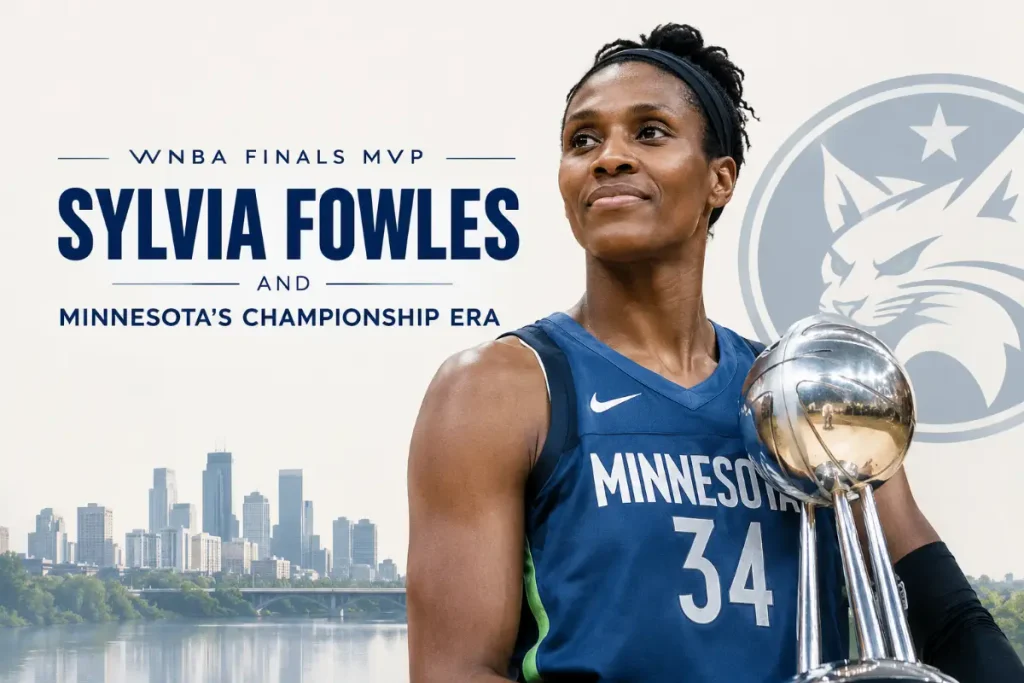
Sylvia Fowles and Minnesota’s Championship Era
Sylvia Fowles won Finals MVP in 2015 and 2017 while playing for the Minnesota Lynx.
Fowles was known for her interior defense, rebounding, finishing around the basket, and physical presence. Her contributions helped Minnesota compete at the highest level during one of the franchise’s strongest periods.
Her performances also demonstrate why defensive players deserve serious consideration for championship honors. Protecting the paint, limiting second-chance opportunities, and controlling rebounds can change a series even when those contributions receive less attention than scoring totals.
Minnesota’s success during that period depended on several outstanding players, but Fowles’ presence in the middle provided an important foundation.
Breanna Stewart’s Championship Impact
Breanna Stewart earned Finals MVP honors in 2018 and 2020 with the Seattle Storm.
Stewart’s versatility made her an especially difficult matchup. She could score from different areas of the floor, rebound effectively, defend multiple positions, and create problems for opponents through her length and mobility.
Seattle’s championships during those seasons reflected a team capable of balancing individual talent with disciplined execution. Stewart’s role demonstrated how a versatile forward can influence nearly every part of a game.
Her two awards also place her among the standout repeat winners in Finals history. They highlight the value of players who can adjust to different defensive schemes while maintaining efficient production.
A’ja Wilson’s Growing Legacy
A’ja Wilson’s Finals MVP wins in 2023 and 2025 established her as one of the defining championship players of the modern WNBA.
Wilson combines interior scoring, rebounding, shot-blocking, and mobility. She can take over a game offensively while also changing opponents’ decisions near the basket.
Her 2023 Finals performance helped the Aces defeat the New York Liberty in four games. She averaged 21.3 points and 12.5 rebounds per game, along with 1.3 blocks per game, according to the league’s historical record.
The 2025 championship added another level to her postseason legacy. Her higher scoring average, consistent double-doubles, and clutch Game 3 basket showed how she could control a series from start to finish.
Wilson’s two Finals MVP awards are separate from her regular-season MVP honors. Her success in both categories reflects her ability to excel across the full season and deliver when a championship is at stake.
Other Standout Finals MVP Winners
Several other winners deserve recognition for their contributions to championship basketball.
Tamika Catchings won the award in 2012 after helping the Indiana Fever capture their first WNBA title. Her defense, rebounding, leadership, and all-around game made her one of the league’s most respected players.
Maya Moore earned the honor in 2013 with the Minnesota Lynx. She combined scoring talent with strong positional versatility and helped Minnesota continue its run as a championship contender.
Emma Meesseman won in 2019 with the Washington Mystics. Her offensive skill and ability to contribute within a balanced team system were central to Washington’s title run.
Kahleah Copper received the award in 2021 with the Chicago Sky. Her scoring and aggressive play helped Chicago win its first championship.
Chelsea Gray won in 2022 with the Las Vegas Aces. Her playmaking, shot creation, and ability to control important possessions earned her recognition during the team’s title run.
Jonquel Jones claimed the 2024 award with the New York Liberty. Her rebounding, interior scoring, and defensive presence helped New York capture its first WNBA championship.
These performances show that there is no single formula for earning the award. Championship value can come from dominant scoring, defensive control, efficient shooting, or the ability to make teammates better.
Which Player Has Won the Most Finals MVP Awards?
Cynthia Cooper holds the record for the most Finals MVP awards, with four consecutive wins from 1997 through 2000.
Her achievement stands out because she won during the WNBA’s first four seasons, helping Houston build an early championship dynasty. No other player has matched her run of four consecutive Finals MVP honors.
Among other repeat winners, Lisa Leslie won twice, Diana Taurasi won twice, Sylvia Fowles won twice, Breanna Stewart won twice, and A’ja Wilson won twice through the 2025 season.
Repeated wins indicate more than individual skill. They often reflect a player’s ability to stay healthy, perform consistently in the postseason, and remain part of a team that can reach the Finals and win a championship.
Does Every Championship Team Have a Finals MVP?
Yes. The WNBA has named a Finals MVP for every championship season since the league began in 1997.
The winner usually comes from the championship team, as the award recognizes the most valuable performance in the series. The historical list reflects the player who stood out during each year’s Finals, not necessarily the best player across the entire season.
That distinction matters because a championship run can feature different leading contributors. A player who has an excellent regular season might take on a different role in the Finals, while a teammate emerges as the most influential performer during the title series.
Section 3: Award Rules, Comparisons, and Frequently Asked Questions
What Is the Difference Between Regular-Season MVP and Finals MVP?
The regular-season MVP and Finals MVP awards recognize different achievements.
The regular-season MVP honors the player judged most valuable across the regular season. Voters consider performance over a much larger sample of games, including scoring, defense, efficiency, consistency, and the player’s influence on team success.
The Finals MVP focuses specifically on the championship series. It rewards the player whose performance stands out most during the final stage of the playoffs.
A player can win both awards in the same season, but one does not guarantee the other. Regular-season success can establish a player’s reputation, while the Finals offer a separate opportunity to demonstrate championship-level impact.
For example, A’ja Wilson won the regular-season MVP in 2025 and also earned Finals MVP after leading the Aces to the championship. Her achievements in both categories reflected success across two different competitive settings.
How Is the Finals MVP Winner Selected?
The award is determined through the league’s established Finals MVP voting process. The selection recognizes the player considered most valuable over the championship series.
Performance statistics provide important evidence, but the decision is not simply based on points per game. Voters can consider several factors, including:
- Scoring and shooting efficiency.
- Rebounds and second-chance opportunities.
- Assists and playmaking.
- Defensive stops, steals, and blocks.
- Clutch performances in close games.
- Consistency throughout the series.
- Leadership and influence on the team’s championship success.
A player’s overall contribution matters because basketball involves more than individual scoring. A center who controls the paint or a guard who creates high-quality shots for teammates can have an enormous influence on the outcome.
The league’s published historical records identify the award recipient for each completed season. For the latest confirmed results and historical names, the official WNBA award history is the best starting point.
Can a Player Win Finals MVP Without Leading the Team in Scoring?
Yes. Scoring is important, but it is not the only measure of value.
A player might earn the award through dominant defense, efficient shooting, rebounding, playmaking, or a combination of these skills. The winner does not need to lead every statistical category.
For example, a defensive anchor may prevent opponents from scoring near the basket while creating extra possessions through rebounds. A point guard may organize the offense, limit turnovers, and set up teammates for easy baskets.
The award considers the overall effect of a player’s performance on the championship series. That broader view helps explain why winners have come from different positions and playing styles throughout WNBA history.
Which Team Has Produced the Most Finals MVP Winners?
The historical list includes several franchises with multiple award-winning players. Houston’s early dynasty stands out because Cynthia Cooper won four consecutive awards, while Los Angeles produced Lisa Leslie’s back-to-back wins.
Seattle also features prominently through Lauren Jackson and Breanna Stewart, while Minnesota’s championship era included Sylvia Fowles and Maya Moore. More recently, Las Vegas has benefited from the outstanding postseason performances of Chelsea Gray and A’ja Wilson.
These examples show how a franchise’s championship success often involves several generations of elite talent. However, team championships and individual award totals are different records, so they should be compared separately.
Is the Finals MVP the Same as the NBA Finals MVP?
No. The WNBA Finals MVP and NBA Finals MVP are separate awards presented for two different professional basketball leagues.
The WNBA award recognizes the standout performer in the WNBA championship series. The NBA award recognizes the most valuable player in the NBA Finals.
Both honors celebrate championship excellence, but their winners, histories, and voting processes belong to their respective leagues. Fans researching award records should use the correct league’s official historical sources.
Who Won the First WNBA Finals MVP Award?
Cynthia Cooper won the first award in 1997 while playing for the Houston Comets.
She helped the Comets win the inaugural WNBA championship and went on to collect the award in 1998, 1999, and 2000. Her four-year run remains one of the most remarkable individual achievements in the league’s championship history.
Cooper’s success helped establish the Finals MVP award as a meaningful part of the WNBA’s annual championship celebration.
Who Won the Award in 2024?
Jonquel Jones of the New York Liberty won the 2024 Finals MVP award.
The Liberty defeated the Minnesota Lynx in the Finals to capture the first championship in franchise history. Jones played a major role through her scoring, rebounding, and presence around the basket.
Her selection also highlighted the importance of a balanced team effort. New York had several influential players, but Jones’ performance across the series earned her the individual honor.
Who Won the Award in 2023?
A’ja Wilson won in 2023 after leading the Las Vegas Aces past the New York Liberty.
Wilson averaged 21.3 points and 12.5 rebounds per game during that Finals series. Her work on the boards and her ability to produce in key moments helped Las Vegas secure the championship.
That award became an important part of Wilson’s postseason résumé and set the stage for her later championship success in 2025.
Has the 2026 Finals MVP Been Announced?
As of October 19, 2026, the 2026 WNBA Finals are underway, so the season’s Finals MVP has not yet been confirmed in the available historical records.
The 2026 championship series features the Atlanta Dream and Golden State Valkyries, with both teams seeking their first WNBA title. The award winner will depend on the completed Finals series and the league’s official announcement.
For the most reliable update, check the WNBA’s official website and its championship coverage.
Why Does the Finals MVP Award Matter?
The award gives fans a clear way to recognize the player who made the greatest impact during the most important series of the season.
Championships require teamwork, coaching, preparation, and contributions from an entire roster. Still, an individual award can highlight a player whose performance changes the direction of a series.
The honor also helps preserve the league’s history. Looking back at past winners reveals the stars who shaped different championship eras, from Cooper’s Houston dynasty to Wilson’s modern success with Las Vegas.
For players, winning the award can become a defining career achievement. For fans, it creates another way to compare legendary performances and appreciate the different skills that lead to a title.
Final Thoughts
The history of the wnba finals mvp award reflects the growth of women’s professional basketball and the remarkable players who have defined its championship moments.
Cynthia Cooper established the early standard with four consecutive wins, while stars such as Lisa Leslie, Diana Taurasi, Sylvia Fowles, and Breanna Stewart built their own championship legacies. More recently, Jonquel Jones, Chelsea Gray, and A’ja Wilson have delivered performances that helped define a new era of WNBA competition.
Wilson’s 2025 victory stands out for its combination of dominant statistics, clutch scoring, and a four-game championship sweep. As the 2026 Finals continue, fans have another opportunity to watch a new chapter unfold.
For anyone following WNBA history, the award remains an important measure of individual excellence under championship pressure. The names on the winners list tell the story of the league’s greatest Finals performances, one season at a time.