Search Intent: Informational — fans want the final score, player statistics, standout performances, and a clear explanation of how the game unfolded.
Editorial note: This article covers the September 14, 2026, regular-season matchup between the Kansas City Chiefs and Denver Broncos. The Chiefs won 31–10. The statistics below are based on published game records.
Monday Night Football
Arrowhead Stadium • Kansas City, MO
Broncos
0-1
10
Final
Sep 14
31
Chiefs
1-0
OverviewTeam StatsPlayer StatsPlay-By-Play

Game Overview: Chiefs Defeat Broncos 31–10
The Kansas City Chiefs opened their 2026 regular season with a convincing 31–10 victory over the Denver Broncos on September 14 at GEHA Field at Arrowhead Stadium in Kansas City, Missouri. Kansas City controlled the game with a powerful rushing attack, timely passing plays, and an offense that consistently moved the chains.
The biggest story was running back Kenneth Walker III, who made an immediate impact in his Chiefs debut. He rushed for 173 yards and scored a rushing touchdown, including a spectacular 60-yard run in the third quarter. He also caught a touchdown pass from quarterback Patrick Mahomes.
Mahomes, meanwhile, returned to action following a season-ending knee injury and delivered an effective performance. He threw for 184 yards and two touchdowns while adding another score on the ground.
Denver struggled to match Kansas City’s offensive production. Quarterback Bo Nix completed 17 of 28 passes for 131 yards and one touchdown, but he also threw an interception and lost two fumbles. The Broncos finished with only 176 total yards compared with Kansas City’s 392.
Here is a quick look at the final result and the most important numbers from the game.
| Game statistic | Denver Broncos | Kansas City Chiefs |
|---|---|---|
| Final score | 10 | 31 |
| Total yards | 176 | 392 |
| Passing yards | 115 | 172 |
| Rushing yards | 61 | 220 |
| First downs | 9 | 19 |
| Total plays | 47 | 67 |
| Third-down conversions | 2/12 | 9/17 |
| Turnovers | 2 | 1 |
| Time of possession | 26:18 | 33:42 |
Source: NFL game records and CBS Sports box score.
These figures explain why Kansas City won comfortably. The Chiefs gained more than twice as many total yards as Denver and controlled possession for over seven additional minutes.
Chiefs vs Broncos Match Player Stats: Complete Passing, Rushing, and Receiving Breakdown
Fans often want more than the final score. They want to know which quarterback played better, who led the rushing attack, which receivers made the biggest contributions, and which mistakes changed the game.
The following breakdown covers the leading offensive performers from both teams.
1. Quarterback Passing Stats
The quarterback matchup featured Patrick Mahomes for Kansas City and Bo Nix for Denver. Both quarterbacks threw a touchdown pass, but Mahomes benefited from stronger support from his rushing offense.
| Passing statistic | Patrick Mahomes | Bo Nix |
|---|---|---|
| Team | Chiefs | Broncos |
| Completions | 15 | 17 |
| Pass attempts | 27 | 28 |
| Completion percentage | 55.6% | 60.7% |
| Passing yards | 184 | 131 |
| Passing touchdowns | 2 | 1 |
| Interceptions | 1 | 1 |
| Sacks taken | 2 | 4 |
| Passing rating | 86.0 | 69.2 |
Source: Pro-Football-Reference and published game statistics.
Patrick Mahomes: A productive return
Mahomes completed 15 of 27 passes for 184 yards, two passing touchdowns, and one interception. He also rushed seven times for 23 yards and scored a rushing touchdown on a 15-yard run in the first quarter.
His passing numbers were not perfect, but his overall contribution helped Kansas City build a lead and maintain control. He connected with Rashee Rice for a 13-yard touchdown in the second quarter and later found Walker for a short scoring pass in the fourth.
Mahomes also showed that he could contribute as a runner when the opportunity appeared. His rushing touchdown gave Kansas City an early advantage and helped establish the tone for the game.
The interception was a mistake, but it did not prevent the Chiefs from producing four offensive touchdowns. His ability to contribute through both the air and on the ground made him a central part of the victory.
Bo Nix: A difficult afternoon for Denver
Nix completed 17 of 28 passes for 131 yards, one touchdown, and one interception. His completion percentage was higher than Mahomes’ figure, but his overall passing production was lower.
He connected with tight end Evan Engram for a 19-yard touchdown in the first quarter. That score temporarily tied the game at 7–7 and gave Denver an encouraging start.
However, the Broncos struggled to generate consistent offense after that opening period. Nix was sacked four times, and Denver finished with just 115 net passing yards.
His interception and two lost fumbles also hurt the team’s chances. Against an opponent that was scoring regularly, Denver needed to protect the football and sustain longer drives.
2. Rushing Stats: Kenneth Walker III Leads the Chiefs
Kansas City’s ground game was the biggest difference between the two teams. The Chiefs gained 220 rushing yards, while Denver managed only 61.
Kenneth Walker III led the way with 173 rushing yards on 23 attempts. His average of 7.5 yards per carry showed how frequently he turned ordinary running plays into significant gains.
| Rushing player | Team | Carries | Rushing yards | Average | Rushing TD |
|---|---|---|---|---|---|
| Kenneth Walker III | Chiefs | 23 | 173 | 7.5 | 1 |
| Patrick Mahomes | Chiefs | 7 | 23 | 3.3 | 1 |
| Emmett Johnson | Chiefs | 8 | 24 | 3.0 | 0 |
| J.K. Dobbins | Broncos | 8 | 36 | 4.5 | 0 |
| RJ Harvey | Broncos | 3 | 18 | 6.0 | 0 |
| Troy Franklin | Broncos | 1 | 5 | 5.0 | 0 |
| Bo Nix | Broncos | 3 | 2 | 0.7 | 0 |
Source: Pro-Football-Reference game box score.
Kenneth Walker III: The standout performer
Walker was the most productive offensive player in the matchup. He carried the ball 23 times for 173 yards and scored a rushing touchdown.
His most memorable play came in the third quarter. With Kansas City leading 14–7, Walker broke free for a 60-yard touchdown run that pushed the lead to 21–7. The explosive play changed the momentum and put additional pressure on Denver’s offense.
Walker also contributed as a receiver, catching three passes for 18 yards and a touchdown. His ability to produce on the ground and through the passing game gave Kansas City another way to attack the defense.
For a player making his Chiefs debut, the performance was an immediate statement. He gave Mahomes a reliable option in the backfield and helped Kansas City avoid relying entirely on the passing game.
Denver’s rushing attack
J.K. Dobbins led Denver’s rushing group with 36 yards on eight carries. RJ Harvey added 18 yards on three attempts, while Nix recorded two rushing yards on three carries.
Those numbers were not disastrous on a per-carry basis for every player, but Denver did not generate the volume or explosive scoring plays needed to keep up with Kansas City.
The Broncos finished with 61 rushing yards as a team. That limited production made it harder to control possession, protect Nix, and keep the Chiefs’ offense off the field.
3. Receiving Stats: Travis Kelce Leads Kansas City
Kansas City’s receiving production was spread across several players, but Travis Kelce stood out for his ability to gain significant yardage on limited catches.
Kelce caught three passes for 71 yards. His longest reception covered 59 yards, making him the Chiefs’ leading receiver by yardage.
| Receiving player | Team | Receptions | Receiving yards | Longest catch | Receiving TD |
|---|---|---|---|---|---|
| Travis Kelce | Chiefs | 3 | 71 | 59 | 0 |
| Emmett Johnson | Chiefs | 2 | 44 | 25 | 0 |
| Rashee Rice | Chiefs | 2 | 19 | 13 | 1 |
| Kenneth Walker III | Chiefs | 3 | 18 | 11 | 1 |
| Xavier Worthy | Chiefs | 3 | 18 | 9 | 0 |
| Evan Engram | Broncos | 4 | 43 | 19 | 1 |
| Pat Bryant | Broncos | 4 | 42 | 13 | 0 |
| RJ Harvey | Broncos | 4 | 23 | 11 | 0 |
| Courtland Sutton | Broncos | 2 | 11 | 6 | 0 |
| Adam Trautman | Broncos | 2 | 10 | 6 | 0 |
Source: Published player receiving statistics.
Travis Kelce’s impact
Kelce’s 71 receiving yards came from just three catches. His 59-yard reception gave Kansas City a major gain and demonstrated his ability to stretch the defense.
He did not score a touchdown, but his contribution helped move the offense into favorable field position. Long receptions are particularly valuable because they can turn a difficult drive into an immediate scoring opportunity.
Kelce also reached a notable career milestone during the game, moving into second place among NFL tight ends in career receiving yards with 13,073, surpassing Jason Witten.
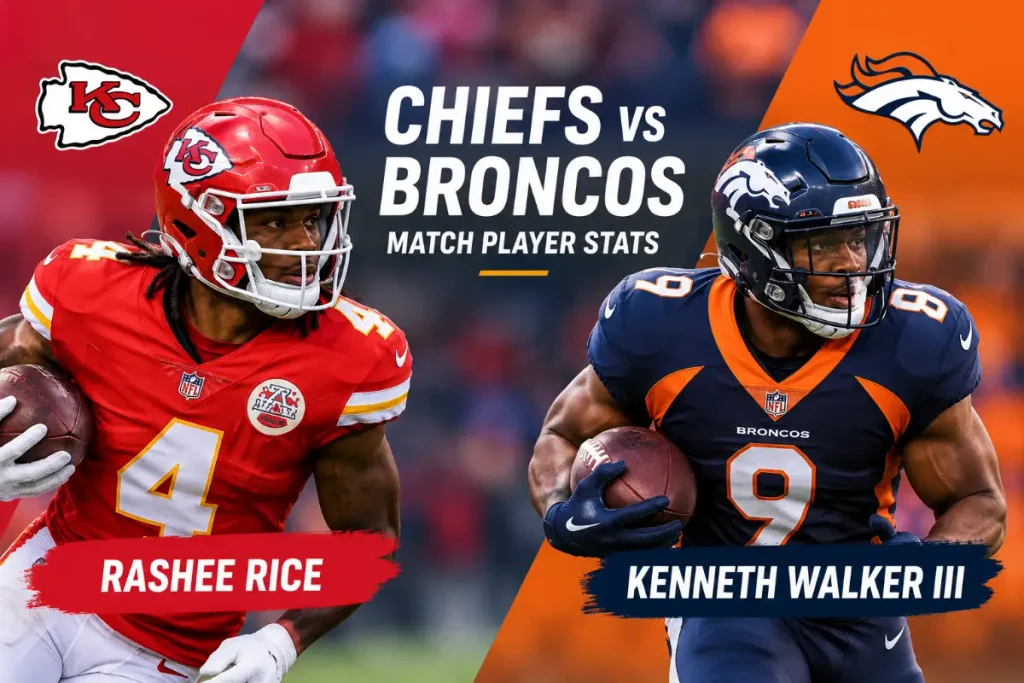
Rashee Rice and Kenneth Walker III
Rice caught two passes for 19 yards, including a 13-yard touchdown reception from Mahomes in the second quarter. That score gave Kansas City a 14–7 lead.
Walker added three catches for 18 yards and a receiving touchdown. His short touchdown reception in the fourth quarter completed the scoring for the Chiefs and highlighted his value as a dual-threat running back.
Emmett Johnson also made a useful contribution, recording two receptions for 44 yards. His receiving total was notable because he added production beyond his 24 rushing yards.
Denver’s leading receivers
Engram led the Broncos with 43 receiving yards and a touchdown on four catches. His first-quarter score was Denver’s only touchdown of the game.
Pat Bryant also caught four passes, finishing with 42 yards. RJ Harvey recorded four catches for 23 yards, giving Nix another option in the passing game.
Courtland Sutton finished with two receptions for 11 yards. Denver’s passing game lacked the explosive plays needed to overcome Kansas City’s advantage on the ground.
Chiefs vs Broncos Match Player Stats: Quarter-by-Quarter Scoring
The score remained competitive early, but Kansas City gradually took control. The Chiefs scored in every quarter, while Denver failed to add any points in the second or fourth periods.
| Quarter | Broncos | Chiefs | Key event |
|---|---|---|---|
| First | 7 | 7 | Mahomes rushed for a touchdown; Engram caught a touchdown pass |
| Second | 0 | 7 | Mahomes connected with Rice for a touchdown |
| Third | 3 | 10 | Walker scored on a 60-yard run; both teams added field goals |
| Fourth | 0 | 7 | Walker caught a touchdown pass from Mahomes |
| Final | 10 | 31 | Kansas City won by 21 points |
Source: Official Chiefs game center and Pro-Football-Reference.
First quarter: Both teams find the end zone
Kansas City opened the scoring when Mahomes ran 15 yards for a touchdown. Harrison Butker converted the extra point to give the Chiefs a 7–0 lead.
Denver answered with a 19-yard touchdown pass from Nix to Engram. Wil Lutz added the extra point, tying the score at 7–7.
The opening quarter suggested that both offenses could produce points. However, the Chiefs would soon establish much greater control over the game.
Second quarter: Kansas City moves ahead
The Chiefs took the lead when Mahomes threw a 13-yard touchdown pass to Rice. Butker’s extra point made the score 14–7.
Denver could not respond with another touchdown before halftime. Kansas City’s defense began limiting the Broncos’ ability to put together sustained drives, while the Chiefs entered the second half with a seven-point advantage.
Third quarter: Walker changes the game
Walker delivered the game’s defining offensive moment with his 60-yard rushing touchdown. The score pushed Kansas City’s lead to 21–7 and gave Denver a much more difficult challenge.
The Broncos responded with a 31-yard field goal from Lutz, reducing the deficit to 21–10.
Kansas City then added a 28-yard field goal by Butker. The Chiefs ended the third quarter ahead 24–10, with momentum firmly on their side.
Fourth quarter: The Chiefs finish strongly
Kansas City scored again when Mahomes threw a short touchdown pass to Walker. Butker converted the extra point, extending the lead to 31–10.
Denver failed to score in the final quarter. Kansas City protected its advantage and completed a convincing season-opening victory.
4. Team Statistics That Explain the Result
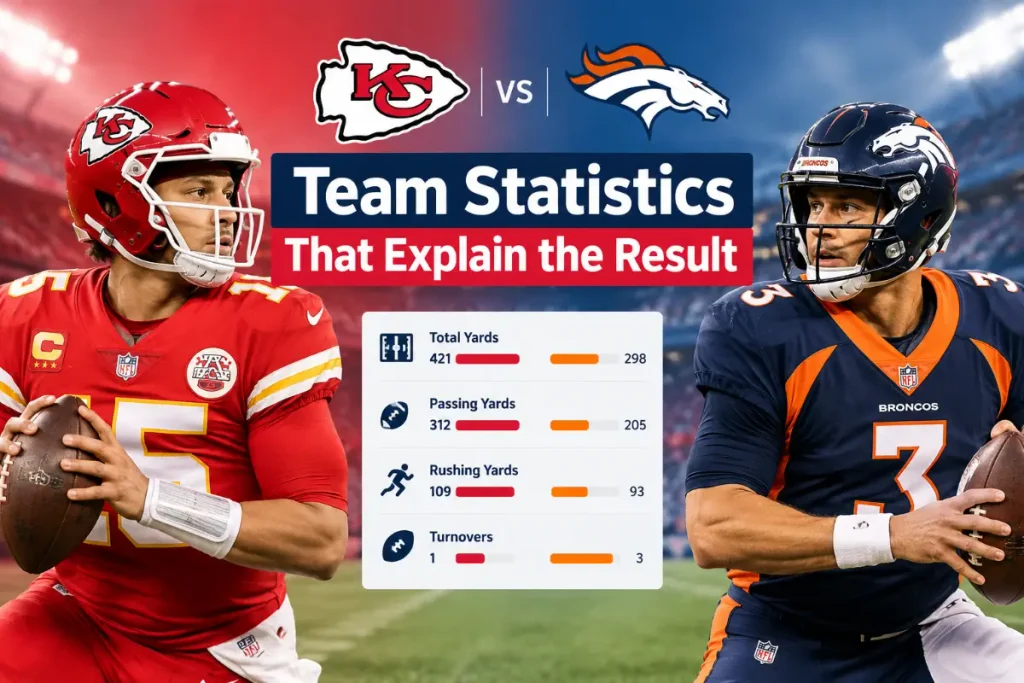
The final score tells only part of the story. The team statistics reveal how Kansas City gained control and why Denver struggled to stay competitive.
Total offensive yards
Kansas City recorded 392 total yards, compared with Denver’s 176. The 216-yard difference reflected the Chiefs’ ability to gain yards through both rushing and passing.
The Broncos were unable to produce enough first downs or sustained drives to keep pace.
Rushing production
The Chiefs gained 220 rushing yards on 38 attempts, averaging 5.8 yards per carry. Denver managed 61 yards on 15 attempts, averaging 4.1 yards per carry.
Kansas City’s advantage on the ground helped the team control the clock and create favorable situations for Mahomes.
Third-down efficiency
The Chiefs converted nine of 17 third-down attempts, a conversion rate of approximately 52.9%.
Denver converted just two of 12 attempts, or 16.7%.
This was one of the clearest differences between the teams. Kansas City frequently extended drives, while Denver often had to give the ball back before reaching scoring position.
Time of possession
Kansas City possessed the ball for 33 minutes and 42 seconds. Denver held it for 26 minutes and 18 seconds.
The Chiefs’ longer drives helped limit Denver’s opportunities. When an offense combines efficient third-down conversions with a productive rushing attack, it can keep the opposing offense on the sideline for extended periods.
Turnovers
Both quarterbacks threw an interception. However, Denver also lost two fumbles, giving the Broncos two turnovers overall compared with Kansas City’s one.
Turnovers can quickly change the direction of an NFL game. Denver’s mistakes made an already difficult matchup even harder, especially when the Chiefs were producing long rushing gains.
The combination of limited offensive yardage, poor third-down efficiency, and lost fumbles left Denver with little room to recover.
5. Defensive Performance and Key Takeaways
Although the offensive stars attracted much of the attention, Kansas City’s defensive performance was equally important.
The Chiefs held Denver to 176 total yards and nine first downs. They also limited the Broncos to just two successful third-down conversions in 12 attempts. These numbers show how difficult it was for Denver to sustain its offense.
Pressure on Bo Nix
Nix was sacked four times for a combined loss of 16 yards. The pressure reduced Denver’s ability to develop longer passing plays and contributed to the team’s limited net passing production.
Quarterbacks generally perform better when they have enough time to read the defense and find open receivers. Denver’s struggles up front made that process more difficult.
Turnovers made a difference
Nix threw an interception and lost two fumbles. Those mistakes disrupted Denver’s offense and gave Kansas City additional opportunities to maintain control.
Mahomes also threw an interception, so the Chiefs were not mistake-free. However, Kansas City offset its turnover with stronger overall offensive production.
Kansas City’s balanced approach
The Chiefs did not need Mahomes to throw for 300 yards. Instead, they used an effective running game to create balance.
Walker’s 173 rushing yards, Mahomes’ two passing touchdowns, and the team’s 220 total rushing yards allowed Kansas City to score consistently without putting all the pressure on its quarterback.
That balance was one of the strongest signs from the matchup.
6. What the Player Stats Mean for Fantasy Football
For fantasy football managers, the game offered several useful takeaways. Individual scoring systems vary, so these observations focus on player usage and production rather than assigning a universal fantasy point total.
Kenneth Walker III: Walker was the standout fantasy performer. His 173 rushing yards, rushing touchdown, and receiving touchdown gave him an exceptional all-around statistical line. His 23 carries also showed that Kansas City was willing to use him as a major part of the offense.
Patrick Mahomes: Mahomes produced three total touchdowns, combining two passing scores with a rushing touchdown. His interception reduced the value of an otherwise productive performance, but his rushing ability added another scoring route.
Travis Kelce: Kelce’s 71 receiving yards and 59-yard long catch made him an important contributor, even without a touchdown. His performance showed that he could still produce significant yardage on relatively few receptions.
Rashee Rice: Rice’s two receptions included a touchdown. Although his total yardage was modest, the score gave him additional value in fantasy formats that reward touchdowns.
Bo Nix: Nix’s 131 passing yards and one passing touchdown were limited by Denver’s overall offensive struggles. His interception and lost fumbles also hurt his potential fantasy return.
Evan Engram: Engram caught four passes for 43 yards and a touchdown. He was one of Denver’s most productive receiving options and accounted for the team’s only touchdown.
Fantasy takeaway: Walker’s workload and scoring involvement were the clearest positive signs from the game. For the Broncos, the biggest concern was the offense’s inability to sustain drives. One game is not enough to predict an entire season, but usage, efficiency, and scoring opportunities are useful indicators to monitor.
7. Historical Context: Why This AFC West Matchup Matters
The Chiefs and Broncos compete in the AFC West, making their meetings important beyond a single result. Divisional games affect the standings and can influence playoff positioning later in the season.
Denver had taken the AFC West crown from Kansas City before this matchup, according to the Associated Press game report. The Chiefs’ 31–10 win therefore provided an early response and a strong start to the new season.
For Kansas City, the victory demonstrated the potential value of a powerful running game alongside Mahomes’ passing ability. Walker’s performance gave the offense a new dimension and helped reduce the pressure on the quarterback.
For Denver, the game highlighted several areas for improvement. The offense needed to protect the football, improve third-down efficiency, and generate more total yards. The defense also faced the challenge of containing a rushing attack that averaged nearly six yards per carry.
One result does not decide a division title, but a 21-point win can establish momentum and provide useful evidence of what a team does well.
8. What Went Right for the Chiefs?
Several factors combined to produce Kansas City’s convincing victory.
- An explosive rushing performance: Walker averaged 7.5 yards per carry and broke free for a 60-yard touchdown.
- A productive quarterback return: Mahomes threw two touchdown passes and added a rushing score.
- Effective third-down execution: The Chiefs converted more than half their third-down attempts.
- Consistent scoring: Kansas City put points on the board in all four quarters.
- Better ball security overall: The Chiefs committed one turnover, while Denver committed two.
- Receiving contributions from multiple players: Kelce, Rice, Walker, and Johnson all helped move the offense forward.
The combination of these factors made the Chiefs difficult to stop. Even when the passing game had an interception or an incomplete sequence, the rushing attack provided another way to advance the ball.
9. What Must the Broncos Improve?
Denver’s performance also offered several clear lessons.
Protect the quarterback
Four sacks and two lost fumbles created difficult situations for the Broncos. Better pass protection and improved ball security would help the offense remain on the field longer.
Convert third downs
A 2-for-12 third-down record is a major obstacle to winning. Denver needs to find ways to create manageable third-down situations and execute more consistently.
Establish a stronger running game
Dobbins and Harvey produced some positive individual runs, but the team’s total rushing output remained limited. A more consistent ground attack could take pressure off Nix and make the passing offense less predictable.
Create more scoring opportunities
Denver managed one touchdown and one field goal. Against an offense that scored 31 points, that was not enough.
The Broncos need more sustained drives and better execution in scoring territory. Improving those areas would help the team compete more effectively in future divisional games.
Frequently Asked Questions (FAQs)
1. What was the final score of the Chiefs vs Broncos game?
The Kansas City Chiefs defeated the Denver Broncos 31–10 on September 14, 2026, at GEHA Field at Arrowhead Stadium in Kansas City, Missouri.
2. Who was the leading rusher in the game?
Kenneth Walker III led all rushers with 173 yards on 23 carries. He averaged 7.5 yards per carry and scored a rushing touchdown. He also caught a touchdown pass.
3. How did Patrick Mahomes perform?
Mahomes completed 15 of 27 passes for 184 yards, two passing touchdowns, and one interception. He also rushed for 23 yards and a touchdown.
4. How many passing yards did Bo Nix record?
Nix threw for 131 yards, completing 17 of 28 passes. He recorded one passing touchdown and one interception, and he was sacked four times.
5. Who led the Chiefs in receiving yards?
Travis Kelce led Kansas City with 71 receiving yards on three catches. His longest reception was 59 yards.
6. Who scored Denver’s only touchdown?
Evan Engram caught a 19-yard touchdown pass from Bo Nix in the first quarter. The score tied the game at 7–7.
7. Which team had more total yards?
Kansas City recorded 392 total yards, while Denver finished with 176. The Chiefs gained 220 rushing yards, compared with 61 for the Broncos.
8. How many turnovers did each team commit?
Kansas City committed one turnover, an interception. Denver committed two turnovers: an interception and two lost fumbles, with the fumbles counted as one turnover category in the team summary.
9. Why did Kansas City win?
The Chiefs combined a powerful rushing attack with effective passing, stronger third-down efficiency, and better overall ball security. Walker’s explosive runs and Mahomes’ three total touchdowns were especially important.
10. Where can fans find the complete box score?
Fans can review the official NFL game center, the Chiefs’ game center, or the detailed box score from Pro-Football-Reference.
Final Thoughts
The September 14 matchup was an impressive start to the season for Kansas City. The Chiefs defeated Denver 31–10 by combining a dominant ground game with timely passing and a defense that consistently disrupted the Broncos’ offense.
Walker was the standout performer, finishing with 173 rushing yards and two total touchdowns. Mahomes added 184 passing yards, two passing touchdowns, and a rushing score. Kelce’s 71 receiving yards also helped Kansas City create explosive plays.
Denver showed early promise through Nix’s touchdown connection with Engram, but the offense struggled to maintain momentum. Limited yardage, poor third-down efficiency, sacks, and turnovers all contributed to the loss.
For readers reviewing the chiefs vs broncos match player stats, the central takeaway is clear: Kansas City controlled the game through its rushing production, balanced offense, and ability to sustain drives. Denver will need better ball security and more consistent offensive execution to challenge the Chiefs in future AFC West meetings.
The final score reflected a game in which Kansas City steadily built its advantage and finished stronger than its division rival.
1 thought on “Chiefs vs Broncos Match Player Stats: (2026 Guide)”