The Colombia vs France international friendly brought together two talented national teams preparing for the 2026 FIFA World Cup. Played on March 29, 2026, at Northwest Stadium in Landover, Maryland, the match gave both countries an opportunity to test their squads, assess tactical combinations, and evaluate players ahead of the tournament.
France earned a 3–1 victory after a strong attacking performance. Désiré Doué scored twice, Marcus Thuram added another goal, and Colombia responded through Jaminton Campaz. The result highlighted France’s attacking depth and ability to create chances through quick transitions, while Colombia showed determination and found a way to score late in the match.
For fans searching for the Colombia vs France lineups, the confirmed starting teams provide a useful look at how both managers approached the contest. France selected a mix of experienced internationals and younger attacking players, while Colombia relied on established names such as James Rodríguez, Luis Díaz, Jefferson Lerma, and Richard Ríos.
This article covers the confirmed starting XIs, formations, key players, substitutes, goals, tactical differences, and the main lessons from the international friendly.
Colombia vs France Match Information
Here are the key details from the game.
| Match detail | Information |
|---|---|
| Match | Colombia vs France |
| Competition | International friendly |
| Date | March 29, 2026 |
| Venue | Northwest Stadium |
| Location | Landover, Maryland, United States |
| Final score | Colombia 1–3 France |
| Colombia scorer | Jaminton Campaz |
| France scorers | Désiré Doué (2), Marcus Thuram |
| Colombia head coach | Néstor Lorenzo |
| France head coach | Didier Deschamps |
France secured the win with three first-half goals before Colombia scored in the second half. The result gave France a positive conclusion to its US friendly tour, while Colombia gained another opportunity to evaluate its options against high-level opposition.
Colombia Starting Lineup
Colombia entered the match with a lineup featuring experienced midfielders, creative wide players, and attacking options capable of testing France’s defense.
Confirmed Colombia Starting XI
Formation: 4-2-3-1, based on the listed player roles
| Position | Player |
|---|---|
| Goalkeeper | Álvaro Montero |
| Right back | Daniel Muñoz |
| Center back | Davinson Sánchez |
| Center back | Juan Cabal |
| Left back | Johan Mojica |
| Defensive midfielder | Jefferson Lerma |
| Central midfielder | Richard Ríos |
| Attacking midfielder | James Rodríguez |
| Right winger | Jhon Arias |
| Left winger | Luis Díaz |
| Striker | Luis Suárez |
The official match report lists these 11 players as Colombia’s starters. The positional arrangement above is a tactical interpretation of the personnel, not a claim that the coach officially announced this exact formation.
Colombia Goalkeeper: Álvaro Montero
Álvaro Montero started in goal for Colombia. His role was important against a French attack that featured pace, movement, and players capable of creating chances from different areas.
A goalkeeper facing France must remain alert to shots from inside the penalty area, quick combinations, and counterattacks. Montero also needed to organize the defense and help the team maintain its shape when France moved forward.
France’s three goals showed how difficult the challenge was. The result also underlined the importance of defensive communication when facing attackers who can exploit even brief lapses in concentration.
Colombia Defense: Muñoz, Sánchez, Cabal, and Mojica
Daniel Muñoz, Davinson Sánchez, Juan Cabal, and Johan Mojica formed Colombia’s starting defensive unit.
Muñoz and Mojica offered options on the flanks, while Sánchez and Cabal were responsible for protecting the central areas. The fullbacks needed to balance their attacking contributions with defensive discipline.
France’s movement created problems because its forwards could move into open spaces, exchange positions, and attack quickly after recovering possession. Colombia’s back line had to track runners while avoiding gaps between the center-backs and fullbacks.
The defensive unit also had to deal with crosses and combinations around the penalty area. Against an opponent with multiple attacking threats, a coordinated back line is essential.
Colombia Midfield: Lerma, Ríos, and James Rodríguez
Jefferson Lerma and Richard Ríos provided the central midfield foundation, while James Rodríguez offered creativity in advanced areas.
Lerma’s responsibilities included winning challenges, disrupting France’s buildup, and protecting the defense. Ríos could help Colombia move the ball forward and connect defensive possession with the attacking players.
James Rodríguez was an important creative option. His passing range and ability to find teammates between the lines offered Colombia a way to progress through midfield.
However, creating chances against France required more than individual technical quality. Colombia needed coordinated movement, accurate passing, and enough support around the ball to prevent France from regaining possession quickly.
Colombia Attack: Jhon Arias, Luis Díaz, and Luis Suárez
Jhon Arias, Luis Díaz, and Luis Suárez formed Colombia’s main attacking group.
Díaz brought pace and dribbling ability from the left side. He could challenge defenders directly, carry the ball into advanced areas, and create opportunities through individual skill.
Arias offered movement and attacking support on the opposite flank, while Suárez operated as the central forward.
The challenge for Colombia was to create enough space for these players to receive the ball in dangerous positions. France’s midfield pressure and defensive organization limited Colombia’s opportunities during the first half.
Colombia eventually found the net through Campaz, who came on as a substitute. His goal demonstrated that the team could still create scoring opportunities even after facing a difficult opening period.
France Starting Lineup
France selected a technically gifted and physically strong team for the friendly. The starting XI included experienced international midfielder N’Golo Kanté alongside younger attacking talents such as Désiré Doué, Rayan Cherki, and Maghnes Akliouche.
Confirmed France Starting XI
Formation: 4-2-3-1, based on the listed player roles
| Position | Player |
|---|---|
| Goalkeeper | Brice Samba |
| Right back | Pierre Kalulu |
| Center back | Maxence Lacroix |
| Center back | Lucas Hernández |
| Left back | Lucas Digne |
| Defensive midfielder | N’Golo Kanté |
| Central midfielder | Warren Zaïre-Emery |
| Attacking midfielder | Rayan Cherki |
| Right winger | Maghnes Akliouche |
| Left winger | Désiré Doué |
| Striker | Marcus Thuram |
The French Football Federation’s official match report confirms these starters. As with Colombia, the formation shown here is an interpretation of the lineup rather than a confirmed official formation.
France Goalkeeper: Brice Samba
Brice Samba started in goal for France. His responsibilities included organizing the defense, handling crosses, and helping the team maintain possession when Colombia pressed.
France’s attacking success meant that Samba was supported by a team capable of keeping pressure on Colombia. However, a goalkeeper remains an important part of the overall defensive structure, particularly when the opposition attempts to counterattack.
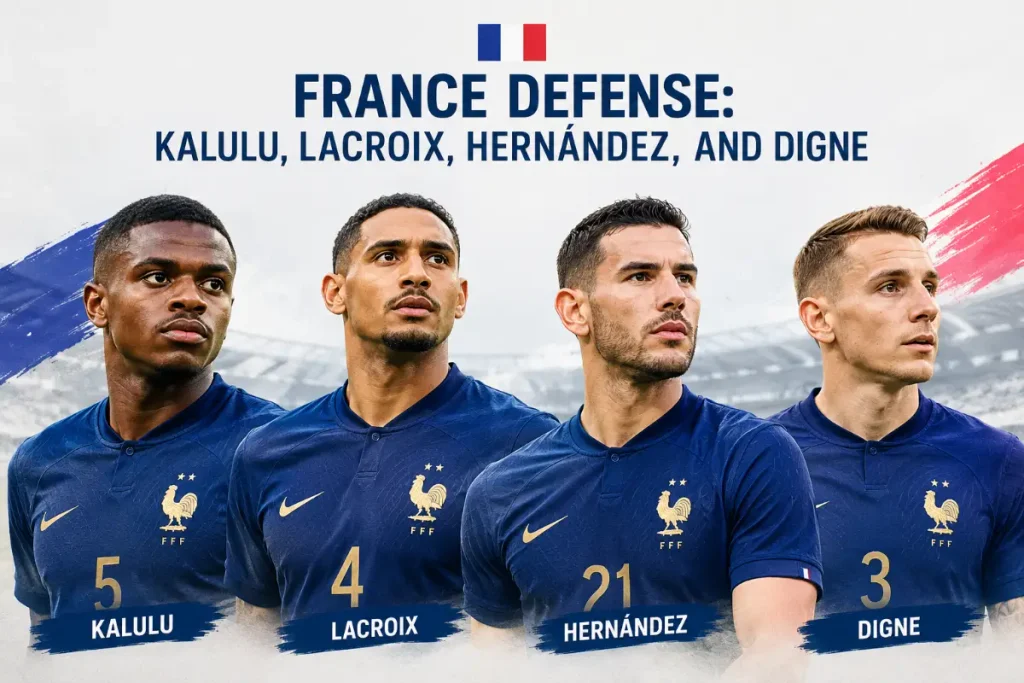
France Defense: Kalulu, Lacroix, Hernández, and Digne
Pierre Kalulu, Maxence Lacroix, Lucas Hernández, and Lucas Digne formed France’s starting back line.
The defenders needed to manage Colombia’s wide threats, particularly Díaz’s ability to take on opponents and move into dangerous areas.
Kalulu also contributed to France’s attacking play. His involvement in the move that led to Thuram’s goal demonstrated how defensive players can support attacks through overlapping runs and accurate delivery.
Lacroix and Hernández helped protect central areas, while Digne offered width from the left. France’s defensive unit was not simply focused on stopping Colombia; it also supported the team’s ability to move the ball forward and create attacking opportunities.
France Midfield: Kanté and Zaïre-Emery
N’Golo Kanté and Warren Zaïre-Emery started in central midfield.
Kanté brought experience, ball recovery, and the ability to cover large areas of the field. His presence helped France compete for possession and disrupt Colombia’s attempts to build attacks.
Zaïre-Emery provided energy and technical quality. His role included connecting midfield with the attacking players and helping France transition quickly when possession changed hands.
Together, the midfielders supported a team that could defend compactly and then attack with speed. This balance was especially valuable against Colombia’s technically gifted midfield.
France Attack: Akliouche, Cherki, Doué, and Thuram
France’s starting attack featured Maghnes Akliouche, Rayan Cherki, Désiré Doué, and Marcus Thuram.
Akliouche offered creativity and movement on the right, while Cherki could operate between the lines and supply forward passes. Doué brought direct attacking ability, and Thuram provided a physical presence in the center-forward position.
The combination worked effectively during the match. France scored three times in the first half, with Doué and Thuram finding the net.
The attacking unit also demonstrated the value of coordinated movement. Rather than relying on one player to create every chance, France used different players to carry the ball, deliver passes, make runs, and finish opportunities.
Key Players in Colombia vs France Lineups
The individual matchups were important because both teams had players capable of changing the game with a single pass, run, or finish.
Luis Díaz — Colombia
Luis Díaz was one of Colombia’s most recognizable attacking players. His dribbling, acceleration, and ability to challenge defenders made him a key part of the team’s forward plan.
Against France, Díaz needed support from nearby midfielders and fullbacks to create useful combinations. When a winger faces two defenders, quick passing and overlapping runs can create space that is difficult to find through dribbling alone.
Díaz’s influence is particularly important when Colombia looks to attack from the left flank and move the ball into the penalty area.
James Rodríguez — Colombia
James Rodríguez provided Colombia with creativity and international experience.
His passing can help unlock defensive lines, especially when he has enough time to look up and identify forward runs. He can also help the team control the tempo and connect the midfield with the forwards.
France’s pressure made those tasks difficult. Colombia needed quick support around James to prevent him from being isolated when receiving possession.
Désiré Doué — France
Doué was one of the biggest difference-makers in the match. He scored twice, demonstrating his ability to turn attacking opportunities into goals.
His performance highlighted the importance of direct movement, quick decisions, and composure in front of goal. France’s attacking structure gave him opportunities to operate in dangerous areas.
Doué’s two goals were central to France’s 3–1 win.
Marcus Thuram — France
Thuram scored France’s second goal. His movement and physical presence gave Colombia’s defenders another problem to manage.
His goal came from an attacking move involving Kalulu and Akliouche, showing how France could create chances through coordinated play rather than individual action alone.
A center-forward who can occupy defenders and finish crosses can be especially valuable when the opposition is trying to protect the middle of the penalty area.
N’Golo Kanté — France
Kanté’s role was less about scoring and more about helping France maintain balance.
His ability to recover possession and cover spaces helped France transition between defense and attack. This work can be especially important in matches where the opposition has creative midfielders who want to play forward quickly.
Match Timeline and Goals
France established control in the first half, scoring three times before Colombia responded after the break.
| Minute | Event | Score |
|---|---|---|
| 29′ | Désiré Doué scores for France | Colombia 0–1 France |
| 39′ | Marcus Thuram scores for France | Colombia 0–2 France |
| 41′ | Désiré Doué scores his second goal | Colombia 0–3 France |
| 77′ | Jaminton Campaz scores for Colombia | Colombia 1–3 France |
The sequence of goals gave France a comfortable advantage before halftime. Colombia’s second-half response reduced the margin, but France maintained its lead until the final whistle.
First Half: France Takes Control
France opened the scoring through Doué in the 29th minute. The goal gave the French team an advantage and increased pressure on Colombia to respond.
Thuram then scored in the 39th minute after an attacking move involving Kalulu and Akliouche. France extended its lead again in the 41st minute, when Doué completed his brace.
Three goals in a short period made the match difficult for Colombia. The team needed to reorganize defensively while finding a way to create chances against France’s pressure.
Second Half: Colombia Responds
Colombia made several substitutions at halftime and continued searching for a goal.
Campaz eventually scored in the 77th minute after a move involving Lerma. The goal gave Colombia something positive to take from the game, even though the team could not complete a comeback.
France’s three-goal advantage from the first half ultimately proved decisive.
Substitutions and Squad Depth
International friendlies give coaches an opportunity to evaluate players beyond the starting XI.
Colombia Substitutions
Colombia introduced Gustavo Puerta, Carlos Gómez, and Jhon Córdoba at halftime. Later changes included Deiver Machado, Jaminton Campaz, Juan Quintero, and other squad options.
Campaz made the biggest impact among the substitutes by scoring Colombia’s only goal.
These changes allowed Colombia to test different attacking combinations and assess how its bench players performed against a strong opponent.
France Substitutions
France also rotated its players during the second half. Eduardo Camavinga, Hugo Ekitiké, Randal Kolo Muani, Michael Olise, and Kylian Mbappé were among the players introduced.
Mbappé came on for Thuram late in the match, while Olise replaced Cherki. These substitutions gave France opportunities to evaluate further attacking combinations and manage playing time.
The depth of the French squad was one of the notable features of the contest. The team could introduce high-quality players without abandoning its overall attacking approach.
Tactical Analysis: Why France Won
France’s 3–1 victory was shaped by its ability to convert attacking opportunities into goals and create problems for Colombia’s defensive organization.
1. Effective Attacking Movement
France’s forwards did not remain static. Their movement created passing options and forced Colombia’s defenders to make decisions about marking and covering space.
This approach helped France generate the opportunities that led to the first-half goals.
2. Quick Transitions
France showed that quick movement after winning possession can be effective against a team looking to build attacks through midfield.
When the ball changes hands, defenders often need time to reorganize. Fast forward passing can take advantage of that brief window.
3. Attacking Contributions From Wide Areas
Kalulu and Akliouche combined during the move that led to Thuram’s goal. Their involvement showed how wide players and fullbacks can work together to create openings.
Attacks from wide areas can force defenders to move away from central positions, creating room for forwards inside the box.
4. Colombia’s Defensive Challenges
Colombia struggled to prevent France from scoring three times before halftime. The team needed better defensive coordination and more control during the periods when France attacked quickly.
The second-half goal from Campaz showed that Colombia remained capable of creating chances, but the early deficit made a comeback difficult.
5. Squad Depth
France’s substitutions demonstrated the number of attacking options available to the coach. Introducing additional quality helped maintain competition for places and gave more players an opportunity to gain international experience.
What the Result Means for Both Teams
For France, the victory offered a positive result during preparations for the 2026 World Cup. Doué’s brace and Thuram’s goal demonstrated the team’s attacking options, while the substitutions allowed the coaching staff to assess more players.
For Colombia, the game offered valuable lessons about defending against elite attacking opponents. The team showed resilience by continuing to compete after conceding three goals, and Campaz’s late strike provided a positive moment.
Friendly matches are useful for identifying tactical strengths and weaknesses. The result matters, but the performance also helps coaches evaluate player combinations, fitness, and squad depth before competitive fixtures.
Neither team should be judged entirely by one friendly. Results in international soccer can be influenced by substitutions, tactical experiments, player availability, and the specific objectives of the coaching staff.
Frequently Asked Questions
What was the final score of Colombia vs France?
France defeated Colombia 3–1 on March 29, 2026. Désiré Doué scored twice, Marcus Thuram added a goal, and Jaminton Campaz scored for Colombia.
Who started for Colombia against France?
Colombia’s starting XI included Álvaro Montero, Daniel Muñoz, Davinson Sánchez, Juan Cabal, Johan Mojica, Jefferson Lerma, Richard Ríos, James Rodríguez, Jhon Arias, Luis Díaz, and Luis Suárez.
Who started for France against Colombia?
France’s starting XI included Brice Samba, Pierre Kalulu, Maxence Lacroix, Lucas Hernández, Lucas Digne, N’Golo Kanté, Warren Zaïre-Emery, Rayan Cherki, Maghnes Akliouche, Désiré Doué, and Marcus Thuram.
Who scored for France?
Désiré Doué scored twice, in the 29th and 41st minutes, while Marcus Thuram scored in the 39th minute.
Who scored Colombia’s goal?
Jaminton Campaz scored Colombia’s goal in the 77th minute.
Did Kylian Mbappé start against Colombia?
No. Mbappé was among France’s substitutes and entered the match in the second half, replacing Marcus Thuram.
Where was Colombia vs France played?
The match took place at Northwest Stadium in Landover, Maryland, in the United States.
Where can I find the official team sheets?
The French Football Federation’s official match report and UEFA’s Colombia vs France lineup page provide confirmed lineup information.
Final Thoughts
The Colombia vs France friendly offered a useful comparison between two national teams with different strengths and attacking approaches. France’s early goals, coordinated movement, and attacking depth helped secure a 3–1 win, while Colombia’s second-half response showed determination despite the difficult scoreline.
The confirmed starting XIs also highlighted the quality available to both coaches. Colombia relied on established players such as James Rodríguez and Luis Díaz, while France benefited from the attacking contributions of Désiré Doué and Marcus Thuram.
For readers researching the Colombia vs France lineups, the key takeaway is that France made better use of its scoring opportunities in this match. The official starting teams, goals, and substitutions provide a clear picture of how the game unfolded and which players had the greatest impact.
1 thought on “Colombia vs France Lineups: Starting XI, and Match Analysis”